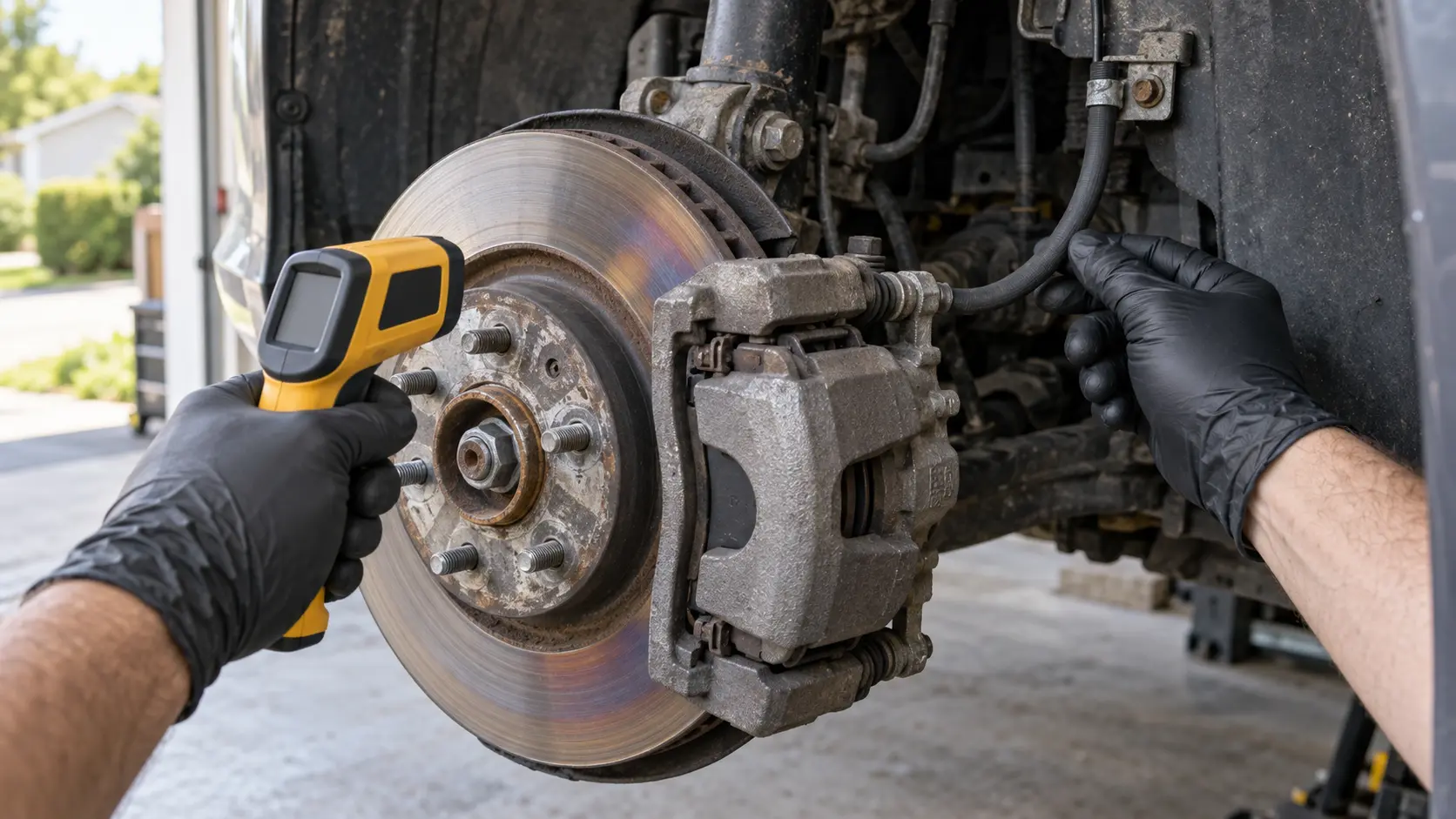
One of the most useful brake questions a driver can ask is simple: “Why is one wheel much hotter than the others after I drive?” Many people assume the caliper must be bad. A sticking caliper is one possibility, but a restricted flexible brake hose, frozen slide pins, rust-bound brake pads, parking-brake hardware, or even a wheel-bearing problem can create similar symptoms.
The heat tells you that something at that wheel may be dragging or failing to release correctly. It does not identify the failed part by itself. That distinction matters because replacing a caliper without finding the real cause can leave the vehicle with the same hot-wheel problem—and may damage another set of pads or rotors.
The system should be checked while the drag is present so the repair addresses the part that is actually holding the brake on.
What does a “hot wheel” actually mean?
Brakes naturally create heat every time they slow the vehicle. The front and rear brakes may not reach identical temperatures because they do different amounts of work. The concern is when one wheel is unusually hot compared with the other wheel on the same axle after ordinary driving, especially when it comes with another symptom.
Watch for:
- A sharp burning smell near one wheel
- Smoke or visible heat coming from the wheel area
- The vehicle pulling while driving or braking
- A car that feels as if it is being held back after the brake pedal is released
- One wheel covered in much more brake dust than the others
- Squealing, scraping, or grinding from one corner
- Shaking after the brakes have become hot
- One pad wearing much faster than the pad on the other side
Do not reach through the wheel and touch the rotor or caliper to check the temperature. Those parts can cause a serious burn. If there is smoke, a strong burning smell, reduced braking, a soft brake pedal, leaking brake fluid, or a severe pull, stop driving and arrange safe transportation or towing.
Cause 1: A sticking brake-caliper piston
The caliper piston pushes the brake pads against the rotor when hydraulic pressure is applied. When the piston or its bore becomes corroded, damaged, or contaminated, the piston may extend but fail to retract enough after the driver releases the pedal.
That leaves the pad rubbing the rotor. The constant friction creates heat, accelerates pad wear, and can discolor or damage the rotor. A damaged piston boot or fluid leak may also be visible, but a caliper can bind without an obvious external leak.
Cause 2: Frozen slide pins or pads stuck in the bracket
On a floating-caliper design, the caliper needs to move smoothly on its guide pins. The brake pads also need the correct clearance to move in the bracket. If a slide pin seizes or corrosion builds underneath the pad hardware, one pad may remain pressed against the rotor even when the piston itself is still working.
This is especially relevant in Central Illinois. Peoria vehicles regularly see winter moisture, road salt, salt brine, temperature changes, and long periods of wet road spray. Corrosion around the bracket, hardware, guide pins, and boots can prevent parts from moving as designed.
This is why “put a caliper on it” is not a complete diagnosis. The inner and outer pads, bracket contact points, guide pins, boots, piston, and rotor faces all need to be checked.
Cause 3: An internally restricted flexible brake hose
The flexible hose carries brake fluid to the caliper as the suspension and steering move. A hose can look acceptable on the outside but become damaged or restricted internally. In some cases, pedal pressure can push fluid toward the caliper, but the pressure releases too slowly when the pedal comes back up.
The result can feel almost identical to a sticking caliper: the pad stays applied, the wheel becomes hot, and the vehicle may pull. Installing a new caliper without checking for trapped hydraulic pressure can miss the hose or another upstream hydraulic problem.
The reverse is also true. Replacing the hose will not fix a seized piston, frozen guide pin, or brake pad wedged into a rusted bracket. The symptoms overlap, so the system has to be tested while the drag is present.
Other problems that can heat one wheel
Not every hot wheel is caused by the front or rear service-brake caliper. Depending on the vehicle, other possibilities include:
- A parking-brake cable or mechanism that is not releasing fully
- Rear parking-brake shoes dragging inside the rotor hat
- An electronic parking-brake fault
- Incorrectly installed or damaged brake hardware
- A wheel bearing that is binding or failing
- Hydraulic pressure coming from farther upstream in the braking system
Recent repair history matters too. If the heat started immediately after pads, rotors, a caliper, a hose, or wheel-bearing work, tell the person inspecting it exactly what was changed and when the symptoms began.
How a technician separates a caliper problem from a hose problem
A good diagnosis looks for evidence instead of guessing from the hottest part. The exact procedure depends on the vehicle, but the inspection may include:
- Confirming the complaint safely. Heat is compared from side to side under controlled conditions, often with a non-contact temperature tool.
- Checking whether the wheel is dragging. With the vehicle safely supported, the wheel can be checked for abnormal resistance.
- Reading the wear pattern. The inner and outer pads may reveal whether the piston, slides, bracket, or hardware is binding.
- Inspecting mechanical movement. The pad fit, guide pins, boots, caliper piston, parking-brake mechanism, and rotor condition are checked.
- Checking the hydraulic side. A technician may test whether releasing trapped pressure changes the drag. If the wheel frees when hydraulic pressure is relieved, the restriction is hydraulic—but that result alone does not prove the flexible hose is the only possible cause.
- Inspecting heat damage. The pads, rotor, seals, hose, and nearby components are evaluated before deciding what can be reused.
- Rechecking after repair. The wheel should rotate and brake normally, and its temperature should be compared again following the vehicle manufacturer's procedure.
Opening a brake bleeder is not a casual do-it-yourself test. Brake fluid handling, correct support equipment, bleeding, torque specifications, and a final safety check are required. The goal here is to explain why the diagnosis is more precise than simply replacing the first hot part.
Why the pads and rotor may also need attention
When a brake drags long enough to create heavy heat, the failed caliper, hose, slide, or hardware may not be the only repair. The overheated pad can glaze, crack, or wear unevenly. The rotor may develop scoring, heat spots, discoloration, thickness problems, or vibration.
That does not mean every hot wheel automatically needs new brake pads and rotors. It means the friction parts must be inspected and measured after the source of the drag is identified. Pads are normally serviced as a set across the axle, not as one loose pad on one wheel.
Can you keep driving with one hot wheel?
Do not treat an abnormally hot wheel as a problem to watch for another week. Brake drag can become worse as heat builds, and that heat can damage parts that were still usable when the problem started.
Stop driving and arrange towing or other safe transportation if you notice:
- Smoke from a wheel
- A strong burning smell that returns
- Major pulling or difficulty keeping the vehicle straight
- Reduced stopping ability
- A soft or sinking brake pedal
- A brake-fluid leak
- A wheel that becomes extremely hot after a short drive
If the vehicle is already parked safely, leave it parked until the condition can be evaluated. Do not take another drive simply to see whether the smell or heat comes back.
What to text for a faster Peoria brake quote
If you contact JL Brake Service about a hot wheel or dragging brake, include:
- Vehicle year, make, and model
- Which wheel seems hot, if known
- Whether the problem happens while driving, while braking, or after the pedal is released
- Any pulling, smoke, smell, noise, warning lights, or pedal changes
- Recent brake, suspension, or wheel-bearing work
- Your ZIP code and whether the vehicle is safely parked
- A clear photo or short video if it can be taken without approaching hot components
Those details help determine whether the next step should be an inspection, an available brake-service appointment, or towing rather than driving the vehicle.
Frequently asked questions
Can a bad brake hose make a new caliper stick?
An internally restricted hose can hold hydraulic pressure at the caliper and make the brake continue dragging after the pedal is released. That can look like a defective replacement caliper. The hose and the rest of the hydraulic path should be considered before another caliper is installed.
Why is my wheel still hot after replacing the brake pads?
New pads do not correct a sticking piston, frozen slide pin, rust-bound pad hardware, restricted hose, or parking-brake problem. New pads are also thicker, so an existing clearance or retraction problem may become noticeable immediately after the repair.
Does one hot wheel always mean the caliper is bad?
No. The caliper is one possible cause, but the flexible hose, guide pins, pad fit, parking-brake mechanism, wheel bearing, and upstream hydraulic pressure may also need to be checked.
Will I need a new rotor after the brake overheats?
It depends on the amount of heat and the rotor's condition. The rotor should be inspected for scoring, cracks, heat spots, discoloration, thickness, and runout or vibration concerns according to the vehicle manufacturer's limits.
Can JL Brake Service inspect a dragging brake at my location?
Scheduled mobile service may be available for qualifying vehicles within the Peoria service area when the vehicle is already in a safe, level, off-street work area and conditions allow. If the brake is smoking, leaking, severely pulling, or not stopping normally, do not drive it to meet an appointment.
Get help with a hot wheel or dragging brake in Peoria
If one wheel is running hot, call or text 309-215-1599. Send the vehicle year, make, model, symptoms, affected wheel, ZIP code, and recent repair history. Jimmy can review the details, explain the appropriate next step, and confirm available Peoria-area brake-service appointments.
Text the symptoms