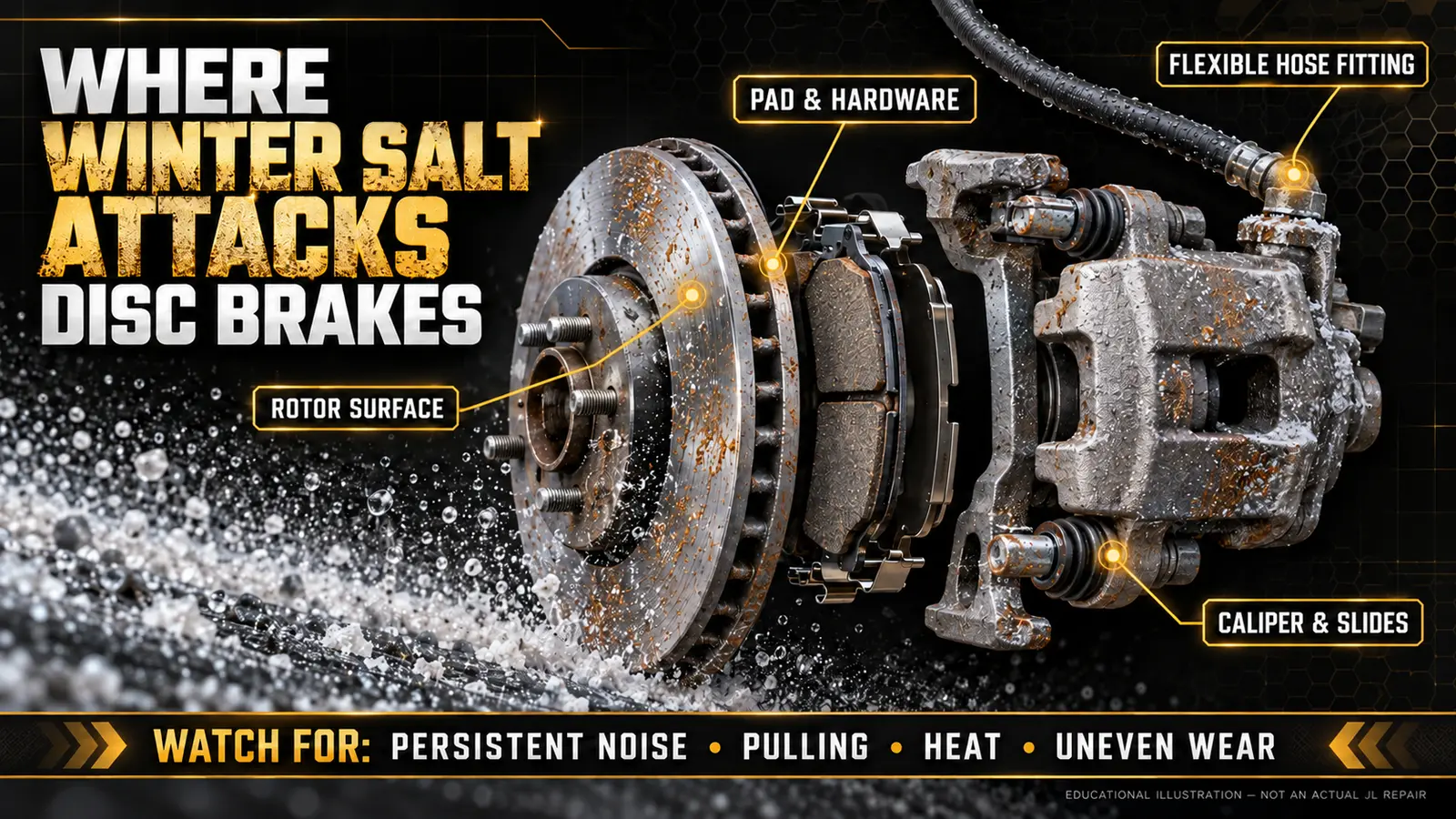
Short answer: salt does not instantly ruin a brake system, and surface color alone does not prove a part should be replaced. The concern is repeated exposure to salt, brine, water, and temperature changes around metal parts that must stay smooth, free-moving, and sealed. In Peoria, that exposure is realistic: the Illinois Department of Transportation says it uses rock salt along with liquid treatments such as salt brine during winter operations.
Where can winter salt affect disc brakes?
Rotor surfaces and cooling vanes
Moisture can leave a thin film on the rotor face after parking. Repeated salty exposure can contribute to heavier scaling or pitting, especially where a vehicle sits for long periods. The rotor still needs to be inspected and measured before replacement is decided.
Pads, clips, and bracket contact points
Rust buildup where a pad must slide can reduce clearance or keep the inner and outer pads from moving evenly. That may contribute to noise, drag, or one pad wearing faster than its mate.
Caliper pistons, slides, and boots
ADVICS lists water and corrosive-chemical exposure among causes of caliper-piston rust, and rust at slide components can interfere with movement. A hot wheel is not proof of a failed caliper, so the hose, pads, bracket, hardware, and release behavior should also be checked.
Flexible hoses and exposed fittings
Flexible rubber hoses, crimps, and fittings live close to road spray. Cracks, wetness, swelling, rubbing, or a change in pedal feel need inspection. A visible leak or soft pedal is a park-the-vehicle issue, not something to monitor while driving.
Is orange rotor rust after rain or snow normal?
A light rotor film after rain, washing, or overnight condensation is common because the rotor friction surface is bare metal. It may make a brief scrape or squeak during the first few normal stops and then clear. JL's guide to brakes squeaking after rain or overnight explains that pattern.
Do not assume every rust-colored rotor is harmless. Noise that stays, a rough or deeply pitted surface, heavy scaling, vibration, pulling, heat, or uneven wear deserves a closer look. ADVICS notes that road salt can accelerate rust and that excessive rotor corrosion can progress to pitting.
What signs suggest corrosion is affecting brake operation?
Pay attention when the vehicle changes
- Noise persists after the first few ordinary stops or becomes a grind
- The vehicle pulls or needs steering correction while braking
- One wheel smells hot, produces more dust, or radiates unusual heat
- One inner or outer pad is much thinner than its matching pad
- The brake pedal becomes soft, low, or slowly sinks
- Brake fluid is visible near a wheel or under the vehicle
- A brake warning light stays on with a change in braking
These symptoms can have causes besides salt. For example, a restricted flexible hose can imitate a sticking caliper, and a tire or bearing concern can overlap with pulling or noise. The pattern tells you what to inspect; it does not name the part to buy.
Do not drive if the pedal is soft or sinking, fluid is leaking, a wheel is smoking, the vehicle pulls severely, stopping distance increases, heavy grinding continues, or the red brake warning light stays on with a braking problem. Arrange towing when the vehicle cannot stop or track safely.
Can you reduce winter salt exposure?
Regular exterior and underbody washing after treated roads have dried can help remove residue from the underside and wheel-well area. A wash is prevention, not a repair: it cannot free a seized slide, restore a pitted rotor, or fix a hydraulic leak. Follow the vehicle and car-wash instructions, let hot brakes cool first, and never put oil, general-purpose lubricant, or a corrosion coating on pad or rotor friction surfaces.
Before the first major Peoria-area salt events, note any current squeal, pull, vibration, heat, or pedal change. After winter begins, pay attention to a symptom that becomes new, stronger, or one-sided. You do not need to replace brakes just because cold weather is coming; you need the actual wear and movement checked when the condition is unknown or the behavior has changed.
What should a salt-related brake check compare?
A useful wheel-off comparison looks at more than the visible outer rotor face. Depending on the complaint and vehicle, it may include:
- Inner and outer pad thickness on both wheels of the axle
- Pad fit and movement in the caliper bracket
- Hardware condition and corrosion at contact points
- Caliper piston, guide-pin, boot, and release condition
- Rotor friction surfaces, edges, cooling vanes, thickness, and heat marks
- Flexible hose condition, routing, fittings, and visible leaks
- Whether both brakes apply and release evenly
If one wheel is already running hot, read one hot wheel: caliper versus flexible brake hose. If the pads do not match, see the guide to uneven brake-pad wear.
How JL handles the next step
JL Brake Service focuses on qualifying Peoria-area mobile disc-brake work, including pads, rotors, confirmed calipers, and flexible brake hoses. Jimmy reviews the vehicle, symptoms, location, work surface, and repair scope before an appointment is accepted. See the current brake service menu and labor pricing; parts, fluid, the mobile booking fee, and any added work are handled as shown in the written quote.
Send the year, make, model, VIN or plate, ZIP code, the wheel or axle if known, and exactly when the symptom occurs. Photos can help show visible rust or a leak, but they cannot confirm pad thickness, caliper movement, rotor measurements, or hydraulic restriction.
Road salt and brake questions
Does an orange brake rotor mean it needs replacement?
No. A light film after moisture can clear during normal braking. Persistent roughness, pitting, noise, vibration, heavy scaling, or a rotor outside the vehicle's limits is different and should be inspected before the repair is chosen.
Can road salt make a brake caliper stick?
Corrosive exposure can contribute to rust at caliper pistons or slide components, but a hot or dragging wheel does not prove the caliper is the only cause. Pad fit, hardware, the flexible hose, and application and release should be checked.
Should I spray lubricant on rusty or squeaky brakes?
No. Never put lubricant on the pad or rotor friction surfaces. Brake-specific lubricants belong only at approved service points and must be applied correctly after the parts are cleaned and inspected.
Should I replace my brakes before winter?
Not because of the calendar alone. Replace parts when inspection, measurements, wear, damage, or vehicle behavior support the repair. If your brake condition is unknown or a symptom is changing, checking it before repeated salt exposure is practical.
Concerned about winter brake corrosion?
Call or text 309-215-1599 with the vehicle, symptom, affected wheel if known, ZIP code, and whether it is safely parked. Jimmy can tell you whether the request fits JL's current Peoria-area mobile service scope.
Text the brake symptomsTechnical sources: Illinois Department of Transportation, Winter Road Conditions: Road Salting 101; ADVICS Aftermarket North America, Checklist: Winter Brake System Issues to Look Out For and Troubleshooting: Seized Caliper. Accessed September 28, 2026.