Short answer: one brake pad can wear faster when the caliper piston, slide pins, pad ears, or hardware do not move freely; when heat or rotor condition differs across the pad; or when a hydraulic problem affects how a brake applies or releases. The exact pattern matters, but uneven wear alone is not enough to name a caliper, hose, or other part. Inspect the complete corner and compare it with the other side before buying parts.
What does the wear pattern actually show?
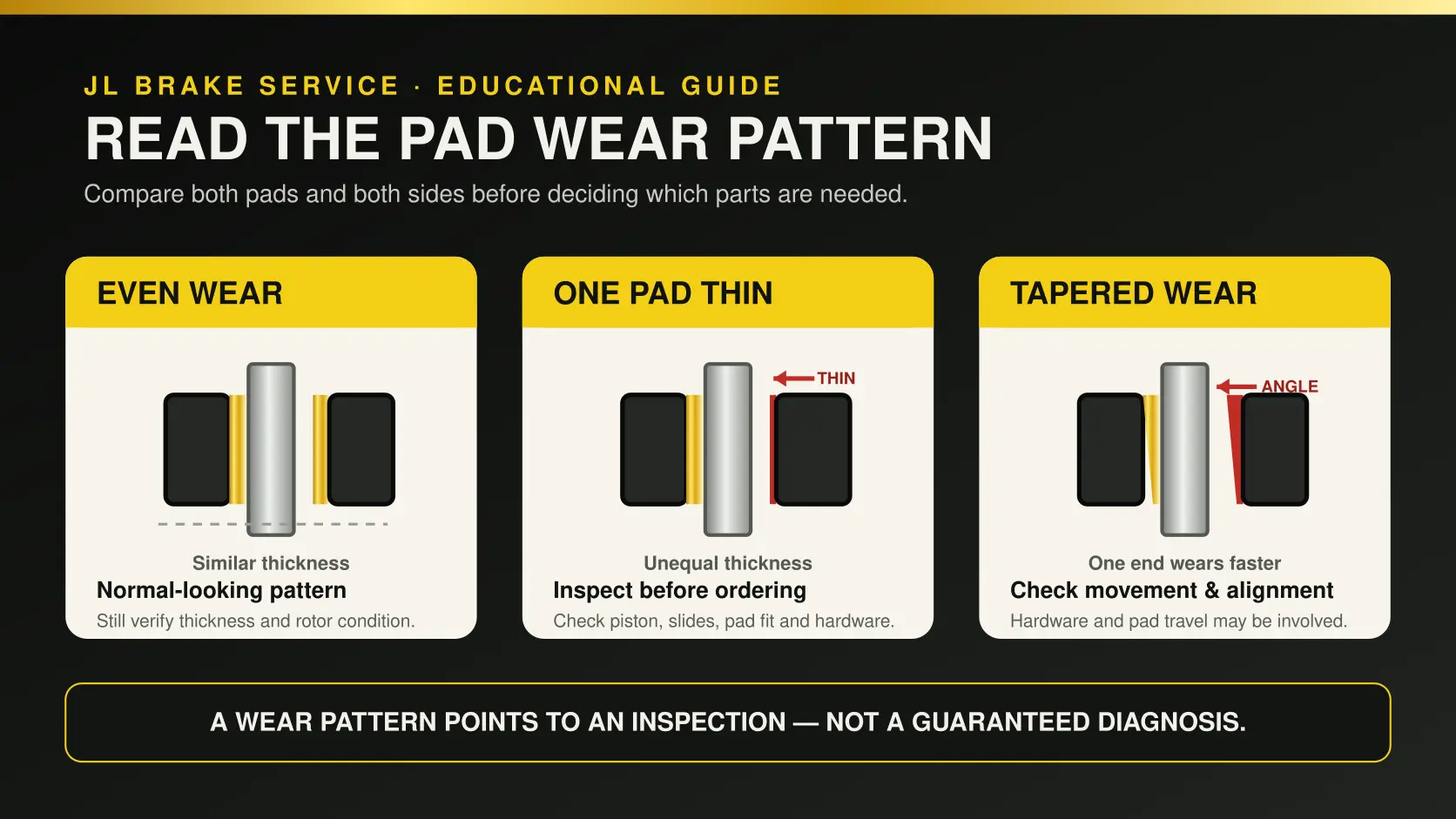
Both pads look similar
Similar inner and outer thickness can fit normal wear, but remaining material, rotor condition, hardware, and the opposite side still need to be checked.
One pad is much thinner
A piston, slide, pad, or hardware movement concern moves higher on the list. Brake drag, heat, and hose behavior may also need testing.
One end is thinner
Tapered wear can point toward pad alignment, hardware, or caliper movement. It should be inspected rather than corrected with pads alone.
ADVICS, a brake-system manufacturer, lists a sticking caliper piston and sticking slide pin among likely causes of premature or uneven pad wear. Its inspection guidance also notes that only one worn pad can indicate a caliper or piston that is hanging up, while tapered wear can point toward hardware concerns. Those clues narrow the inspection; they are not a vehicle-specific diagnosis.
Why one inner or outer pad can wear faster
The caliper piston is not retracting normally
The piston pushes a pad into the rotor when the brakes are applied. If corrosion, a damaged seal or boot, or another mechanical problem keeps the piston from moving and releasing as designed, that pad can stay in contact longer and wear faster. It may also create excess heat, a burning smell, reduced coasting, or pulling.
A slide pin or floating caliper is binding
Many disc brakes use a floating caliper that has to move on slide pins so both pads share the work. A dry, corroded, damaged, or seized slide can change how the inner and outer pads contact the rotor. The pin, boot, lubricant condition, bracket, and caliper movement all matter; seeing one thin pad does not tell you which one failed.
The pad is stuck in the bracket or hardware
A pad needs to move correctly at its contact points. Rust buildup, damaged or misplaced hardware, debris, or an incorrect pad fit can prevent normal travel. Filing or forcing a pad into place without addressing the underlying fit and corrosion is not a reliable repair. The correct procedure depends on the vehicle and the condition of the bracket and hardware.
The rotor surface or heat pattern is uneven
Grooving, heavy scaling, a damaged friction surface, contamination, or excessive heat can affect how a pad contacts the rotor. Rotor thickness, runout, surface condition, and the mounting face may need to be measured or inspected. A shiny or rough rotor seen through the wheel is only part of the picture.
A flexible hose or hydraulic issue is affecting release
A flexible brake hose can look acceptable outside yet still affect pressure or release internally. That can mimic a sticking caliper and contribute to drag or uneven wear. Hydraulic testing is why a parts list should follow an inspection. JL's guide to one hot wheel, caliper drag, and flexible brake-hose restriction explains the overlap in more detail.
Why Peoria rust-belt conditions belong in the inspection
Illinois winter operations use rock salt and liquid deicers, including salt brine. That does not prove road treatment caused one vehicle's uneven pad wear. It does make corrosion at exposed pad-contact points, brackets, hardware, slide-pin boots, rotor and hub surfaces, and nearby fasteners a practical concern on Peoria-area vehicles.
After several Illinois winters, a clean-looking outer pad does not guarantee the inner pad or the movement behind the caliper is healthy. A wheel-off comparison is more useful than looking through one spoke and ordering whatever appears worn first.
Can I replace the pads and keep the rotors?
Sometimes pads can be the only friction parts needed, but uneven wear makes that decision more dependent on inspection. The rotor must meet the vehicle's thickness and surface requirements, and the cause of the wear must be corrected. Pads are normally serviced as an axle set so both wheels on that axle use compatible friction material and receive the same repair decision.
JL's brake pads and rotors guide for Peoria drivers explains when a pads-only repair may fit and what can make rotors necessary. If a caliper is confirmed, review the current mobile brake-caliper service details.
Do not keep driving to “wear the pads even” if the car pulls hard, a wheel becomes very hot, there is smoke or a strong burning smell, braking distance increases, the pedal feels soft or sinks, fluid is leaking, severe grinding starts, or a red brake warning light stays on. Do not touch a wheel, rotor, or caliper to compare temperature. Arrange towing when the vehicle cannot stop or track safely.
What a useful uneven-wear inspection should compare
- Inner and outer pad thickness at each wheel on the axle
- Whether either pad is tapered, chipped, glazed, cracked, contaminated, or worn to the backing plate
- Rotor friction surfaces, thickness, grooves, scaling, heat marks, and runout when appropriate
- Caliper piston movement and signs of leakage or boot damage
- Slide-pin, bracket, pad, and hardware movement
- Flexible-hose condition and whether the brake applies and releases normally
- Heat, wheel-bearing movement, tire condition, and related pulling or vibration
That comparison helps separate routine pad wear from a movement, hydraulic, rotor, or nearby wheel concern. JL's Peoria brake inspection page outlines the current brake-focused mobile service scope.
Send these details for a faster first conversation
- Year, make, model, and Peoria-area ZIP code
- Front or rear brakes, if known
- Which pad or wheel appears more worn, if already identified safely
- Any pulling, heat, smell, smoke, grinding, squeaking, or vibration
- Recent brake work and whether you already have parts
- Whether the vehicle is parked on a safe, firm, reasonably level, off-street surface
Current JL labor pricing after the repair is confirmed
Uneven pad wear does not confirm which repair is needed. When disc-brake pad replacement fits the inspection, JL's published labor is $120 for one axle or $200 for front and rear brake pads. Adding rotors with the pad service is another $90 per axle in labor. Brake-caliper replacement labor starts at $120 per axle. Parts are separate unless the written quote includes them. Vehicle design, corrosion, broken hardware, or added work can change labor; any change should be discussed before extra work begins.
JL schedules qualifying mobile work within roughly 15 miles of Peoria, including many locations in Peoria, Dunlap, Washington, Morton, Germantown Hills, Edwards, East Peoria, Peoria Heights, Pekin, and West Peoria. A $40 mobile booking deposit reserves the appointment and travel; repair labor and parts are separate. Same-day appointments may be available when the correct parts, travel time, weather, and a safe work area line up.
Frequently asked questions
Does uneven brake pad wear always mean the caliper is bad?
No. The piston or caliper slides may be involved, but pad fit, hardware, rotor condition, heat, or a flexible-hose problem can create or contribute to uneven wear. The pattern needs to be checked with the complete brake corner.
Can Peoria road salt make brake pads stick?
Road salt does not diagnose the problem, but corrosion can restrict pad, hardware, or slide movement. On an Illinois vehicle, exposed contact points and boots deserve a careful inspection.
Do both sides need brake pads if only one is worn?
Brake pads are normally replaced as an axle set, not one loose pad. The cause of the mismatch also needs to be corrected, and the rotors and both brake corners must meet the vehicle's service requirements.
Can JL inspect uneven pad wear at my location?
Qualifying mobile inspection or repair may be available within JL's Peoria-area range when the vehicle is already parked on a safe, firm, reasonably level, off-street surface. Jimmy will confirm the vehicle, ZIP code, symptoms, work area, and current scope first.
Tell Jimmy what looks uneven
Call or text 309-215-1599 with the year, make, model, front or rear brakes, symptoms, recent brake work, parts status, and the ZIP code where the vehicle is parked. Jimmy can discuss whether a qualifying Peoria-area mobile inspection or repair fits JL's current scope.
Text the wear detailsTechnical references: ADVICS Aftermarket North America, Troubleshooting Brake Pad Uneven or Premature Wear and Brake System Inspection Checklist; Illinois Department of Transportation, Road Salting 101. Accessed September 14, 2026.