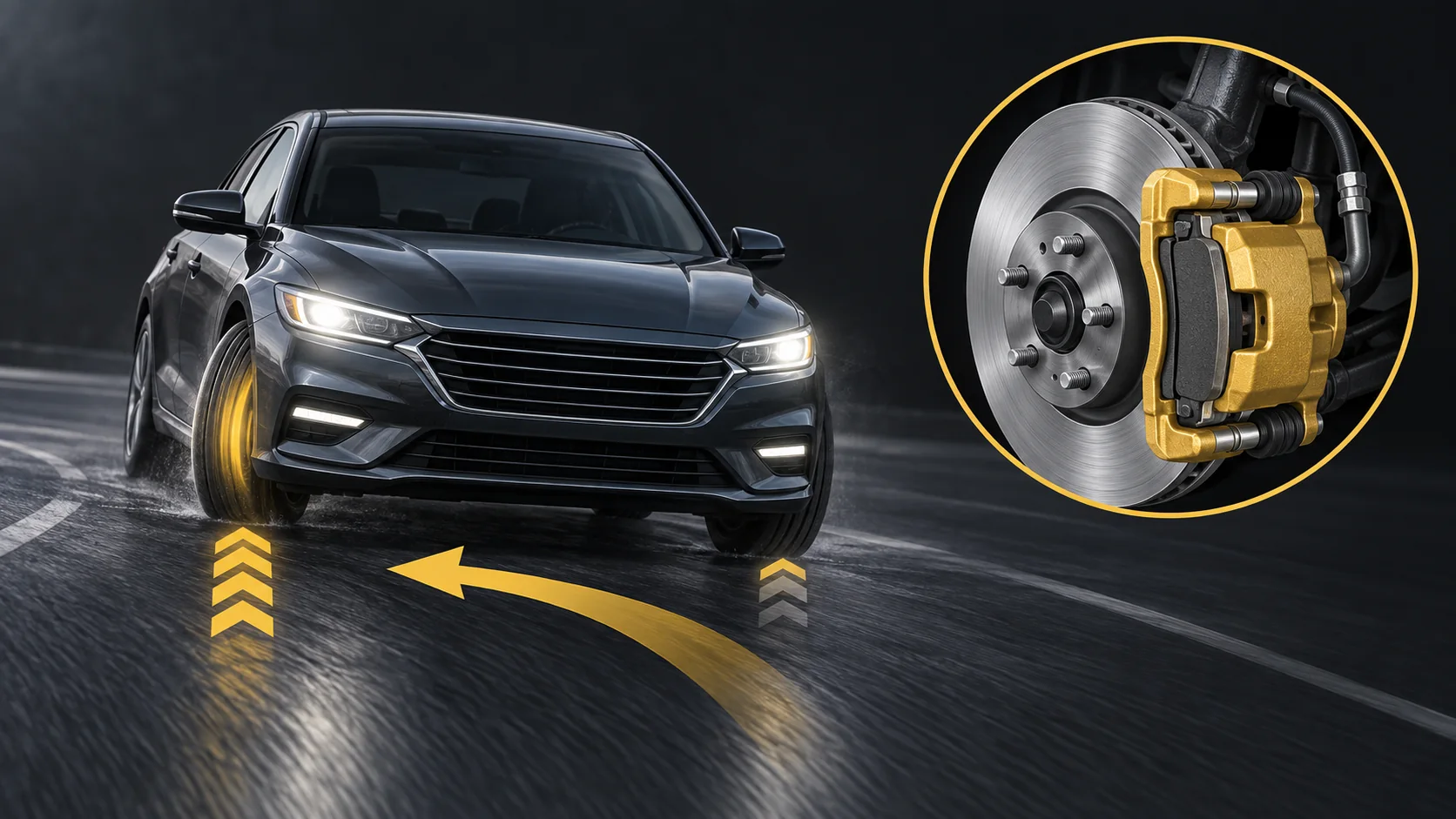
Short answer: if your car pulls left or right mainly when braking, one side may be applying more braking force, one brake may be dragging, or a tire, wheel bearing, steering, or suspension problem may be changing how the vehicle reacts as its weight shifts forward. A sticking caliper is possible, but it is not the only answer. The symptom should be inspected before a caliper, hose, pads, or rotors are ordered.
First, separate brake pull from an everyday drift
Pulls only while braking
Unequal brake application, pad or rotor condition, caliper movement, hydraulic pressure, and front-end movement move higher on the inspection list.
Pulls while cruising too
Tire pressure or damage, alignment, road crown, steering, suspension, and wheel-bearing concerns need attention along with the brakes.
Pulls after the pedal is released
A brake that is slow to release becomes more important—especially if there is heat, a burning smell, reduced coasting, or one wheel running hotter.
A Peoria street may have crown, grooves, patches, or uneven traction that make a mild drift more noticeable. A repeatable pull that begins with brake-pedal pressure, however, should not be dismissed as “just the road.” Describe where it happens and whether the car straightens when you release the pedal.
Five areas that can make a car pull when braking
1. A caliper, slide pin, or brake pad is not moving freely
A floating disc-brake caliper has to apply and release evenly. A sticking piston, seized slide pin, damaged boot, or pad bound in corroded hardware can create different braking force or drag from one side to the other. The wear pattern matters: the inner and outer pads on both sides can reveal a difference that is not visible through the wheel.
Brake-system supplier ADVICS recommends checking for wheel drag, inspecting the brake hose and rotor, and checking caliper rubber parts, slide-pin operation, and uneven pad wear during pad-and-rotor service. Those are inspection points, not permission to name one part from the driver's seat.
2. A flexible brake hose is affecting pressure or release
A flexible hose can be damaged externally or restricted internally. Depending on the failure, one brake may apply weakly or may stay applied longer than it should. That can produce pulling, heat, rapid pad wear, or a burning smell. A hose problem can mimic a bad caliper, so replacing whichever part seems obvious can leave the original cause in place.
If one corner is hot or the vehicle feels held back after a stop, read JL's guide to one hot wheel, a sticking caliper, and a restricted flexible brake hose.
3. The pads or rotor surfaces are not working evenly
One side can respond differently if pad wear is uneven, friction surfaces are contaminated, a rotor is badly rusted or heat-damaged, or prior brake work left different parts or surface conditions side to side. Rotor thickness and runout can matter, but a pull is not proof that both rotors are “warped.” The full wear pattern and condition of both front corners should be compared.
4. A tire or wheel is changing grip
Low tire pressure, a damaged tire, mismatched wear, or a wheel problem can make the vehicle favor one side. Braking shifts weight toward the front tires, so a tire concern that is subtle while cruising may become obvious during a stop. Tire pressure and visible tire condition are simple checks that belong near the beginning—not after expensive brake parts are installed.
5. A wheel bearing, steering, or light-suspension part has movement
Play in a wheel bearing, tie-rod end, ball joint, or control-arm bushing can change wheel position as braking loads the front end. The vehicle may pull, wander, clunk, or feel loose. If there is humming or growling that changes with speed or steering, JL's wheel-bearing noise guide explains the clues worth reporting.
Why Peoria's rust-belt conditions matter
IDOT confirms that Illinois winter operations use rock salt and liquid deicers, including salt brine. That does not prove road treatment caused a particular brake pull. It does make a careful look at exposed pad contact points, caliper hardware, slide pins, rotor and hub surfaces, hose fittings, and nearby fasteners especially practical on Peoria-area vehicles.
A Hyundai/Genesis brake-service bulletin hosted by NHTSA specifically directs technicians to inspect slide pins and boots, check pad surfaces for even wear, remove debris and corrosion from pad-contact areas, and inspect calipers for leaks. The exact procedure and specifications still depend on the vehicle.
Does the direction of the pull tell you which side is bad?
Not reliably enough to order a part. A stronger-applying or dragging brake can tug the vehicle one way, while a weak-applying brake on the opposite side can create a similar driver complaint. Tire grip, road crown, steering geometry, rear-brake behavior, and electronic brake controls can complicate the feel. Record whether it pulls left or right, but let side-to-side inspection and testing identify the cause.
Do not keep testing the vehicle if it changes lanes under braking, feels unstable, needs much more distance to stop, has a soft or sinking pedal, shows a red brake warning light, leaks fluid, grinds severely, smokes, or produces a strong burning smell. Arrange towing when you cannot safely control or stop it.
What a useful brake-pull inspection should compare
- Whether the pull appears only with pedal pressure or also while cruising
- Left-to-right tire pressure, visible condition, and wheel concerns
- Inner and outer pad thickness and wear pattern on both sides
- Rotor friction surfaces, thickness, heat damage, and runout when appropriate
- Caliper piston, slide-pin, pad, and hardware movement
- Flexible hose condition and signs that a brake is applying or releasing unevenly
- Heat, leakage, wheel-bearing play, and nearby steering or suspension movement
JL's Peoria brake inspection page explains the current brake-focused service scope. If a caliper or hose is confirmed, see the dedicated caliper replacement and flexible brake hose replacement pages.
Send these details for a faster first conversation
- Year, make, model, and Peoria-area ZIP code
- Whether it pulls left or right
- Whether it happens only while braking, while cruising, or after release
- Any heat, smell, smoke, grinding, squeaking, vibration, clunking, or pedal change
- Any brake, tire, wheel, bearing, alignment, or suspension work done recently
- Whether the vehicle is parked in a safe, firm, reasonably level, off-street area
Current JL labor pricing when brake parts are confirmed
A pull by itself does not confirm the repair. If inspection supports disc-brake replacement, JL's current published brake pad labor is $120 for one axle or $200 for front and rear together. Adding rotors with the pad service is another $90 per axle in labor. Brake-caliper replacement labor starts at $120 per axle. Parts are separate unless the written quote includes them. Vehicle design, corrosion, broken hardware, or added work can change labor; any change should be discussed before extra work begins.
JL schedules qualifying mobile work within roughly 15 miles of Peoria, including many locations in Peoria, Dunlap, Washington, Morton, Germantown Hills, Edwards, East Peoria, Peoria Heights, Pekin, and West Peoria. A $40 mobile booking deposit reserves the appointment and travel; repair labor and parts are separate. Same-day appointments may be available when the correct parts, travel time, weather, and a safe work area line up.
Frequently asked questions
Does pulling while braking always mean a bad caliper?
No. A caliper or slide may be involved, but a flexible hose, pad or rotor condition, tire, wheel bearing, steering, suspension, or alignment concern can produce or change the same symptom.
Why does my car pull only after I release the brake?
A brake that is slow to release becomes an important possibility. Heat, a burning smell, reduced coasting, or one wheel running hotter makes prompt inspection more important. Do not touch the wheel or brake parts to compare temperature.
Can an alignment make a car pull when braking?
Alignment, tire, and suspension conditions can influence tracking. If the car drives straight until the pedal is pressed, the brake system still deserves priority in the inspection instead of assuming alignment is the whole answer.
Can JL inspect brake pulling at my location?
Qualifying mobile inspection or repair may be available within JL's Peoria-area service range when the vehicle is already parked on a safe, firm, reasonably level, off-street surface. Jimmy will confirm the vehicle, symptom, ZIP code, work area, and current scope first.
Tell Jimmy when the pull starts
Call or text 309-215-1599. Send the year, make, model, which direction it pulls, whether it happens only during braking, any heat or noise, recent repairs, and the ZIP code where the vehicle is parked. Jimmy can discuss whether a qualifying Peoria-area mobile inspection or repair fits JL's current service scope.
Text the pull detailsTechnical references: ADVICS Aftermarket North America, Brake Pad and Disc Rotor Replacement Procedure; Hyundai Motor America, Brake Service Best Practice Recommendations, hosted by NHTSA; Illinois Department of Transportation, Road Salting 101. Accessed September 13, 2026.