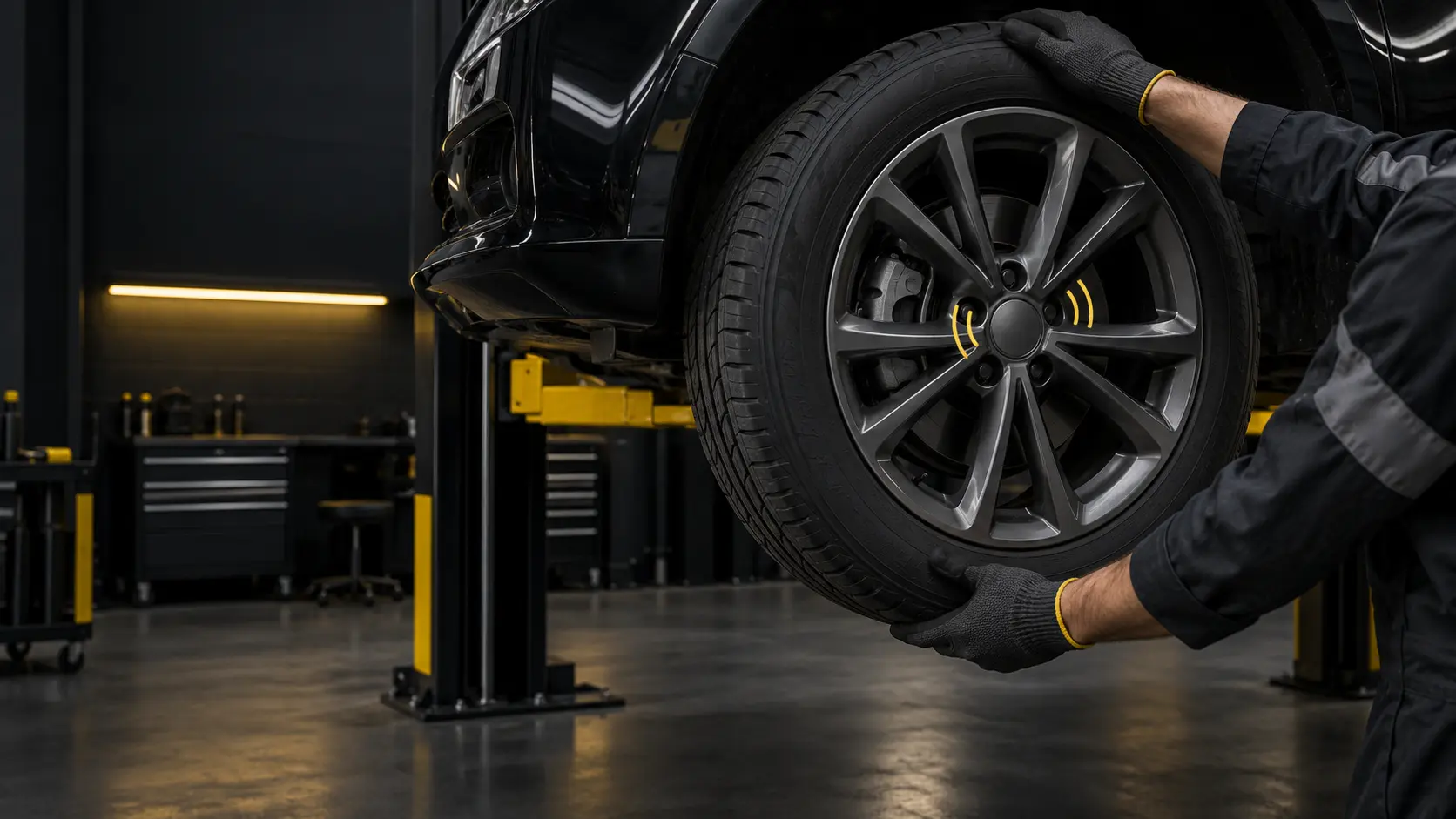
Short answer: a worn wheel bearing often makes a humming, growling, or rumbling sound that rises with road speed and may change when the vehicle's weight shifts in a turn. But a cupped tire, rubbing brake shield, dragging pad, damaged rotor, or another rotating part can imitate it. The sound alone does not identify the side or prove a bearing is bad; the wheel, tire, brakes, hub, and nearby suspension parts should be checked together.
The loudest noise inside the cabin may not come from the side that is actually worn. Body structure carries vibration, and tire or brake noise can travel in much the same way.
What does a bad wheel bearing usually sound like?
People commonly describe bearing noise as an airplane-like hum, low growl, rumble, or rough grinding from one corner of the vehicle. A useful first clue is whether the pitch follows vehicle speed. If the sound grows faster as the wheels turn faster—even while the engine speed changes during a shift—the problem is more likely near a wheel than inside the engine.
Wheel-hub manufacturer GMB lists growling, humming, grinding, looseness, vibration, and uneven tire wear among possible hub-bearing symptoms. Its diagnostic guidance also stresses inspecting the tires and comparing the wheels rather than choosing a part from one symptom. Read GMB's bearing-versus-tire diagnostic overview.
A bearing may become louder or change pitch when turning because the load on each side changes. That is a clue, not a safe do-it-yourself road test. Do not weave or make abrupt steering inputs on public roads just to create the sound.
Wheel bearing noise versus tire noise
Clues that can point toward the tire
Tire tread can produce a deep hum that closely resembles a bearing. Look for uneven or scalloped wear, often called cupping; feathered tread edges; a flat spot; low pressure; or a noise that changes noticeably on different pavement. A tire with an aggressive tread pattern may also become louder as it wears.
Noise that changes after a tire rotation can be useful evidence. It does not automatically mean the tire is the only problem, because looseness or worn suspension parts can contribute to uneven tire wear. Tire condition, wheel balance, alignment clues, and nearby steering or suspension parts may all need attention.
Clues that can point toward the bearing
A bearing becomes more suspicious when a steady hum or growl rises with road speed, stays present across different pavement, and changes as the vehicle loads one side during a normal curve. Roughness when the wheel is safely raised and rotated, measurable looseness, or a clearly different sound from the opposite side adds evidence.
One important limitation: a noisy sealed bearing does not always have obvious looseness. Shaking the tire in the driveway and feeling no movement does not clear the bearing. On the other hand, movement at the wheel can come from a ball joint, tie rod, or another connection rather than the bearing itself.
Wheel bearing noise versus brake noise
Brake noises often give a different set of clues:
- Noise mainly while pressing the brake pedal: pads, rotors, brake hardware, or debris become more likely.
- A light scrape once per wheel rotation: a dust shield, rotor surface, hardware, or another contact point may be involved.
- Grinding with weak braking or a changed pedal: treat it as a brake safety concern and keep the vehicle parked.
- A burning smell or one wheel much hotter than the others: brake drag needs to be ruled out before blaming the bearing.
- A constant hum that barely reacts to brake pressure: the bearing or tire remains possible, but inspection is still required.
If the sound is strongest during braking, compare the guide to persistent grinding brakes in Peoria. If one corner smells hot or drags after the pedal is released, read how a caliper, hose, slide pins, or other parts can create a hot wheel.
Can a wheel bearing turn on the ABS light?
It can, depending on the vehicle. Many modern hub assemblies work with a wheel-speed sensor or encoder used by the anti-lock brake and stability-control systems. Bearing looseness, damaged sensor components, wiring trouble, corrosion, or a different ABS fault can all set a warning light.
An ABS light does not prove the hub needs replacement. The fault codes, wheel-speed data, wiring, connector, sensor design, and mechanical condition should be checked before a part is ordered. A red brake warning light, changed pedal feel, or reduced braking is a separate reason to park the vehicle and arrange proper help.
Why Peoria roads and winters matter
Central Illinois brings freeze-thaw cycles, potholes, moisture, salt, and brine. A hard pothole impact can affect the tire, wheel, alignment, suspension, and hub bearing, while corrosion can make a hub or sensor harder to inspect and remove. That does not mean every Peoria wheel bearing failed because of winter; it means recent pothole impacts and corrosion are useful parts of the history.
GMB's winter guidance explains how pothole impacts can jolt wheel bearings and how freezing and thawing help create road damage. Review the manufacturer's winter hub guidance.
Tell the person inspecting the vehicle whether the noise started after a pothole, curb contact, tire change, brake work, or collision. Also mention whether the sound comes from the front or rear, begins at a certain speed, changes on normal curves, or reacts to light brake pressure.
What a useful wheel-noise inspection checks
The exact process depends on the vehicle, but a careful check may include:
- Confirming the speed, road surface, steering load, and braking conditions that affect the sound.
- Inspecting tire pressure, tread pattern, cupping, feathering, damage, and wheel condition.
- Looking at the brake pads, rotor, caliper, shield, hardware, and signs of rubbing or heat.
- Safely raising the vehicle to check wheel movement, rotation, roughness, and side-to-side differences.
- Checking steering and suspension joints that can create movement or uneven tire wear.
- Reviewing ABS codes and wheel-speed information when warning lights or sensor symptoms are present.
- Identifying whether the vehicle uses a bolt-in hub assembly, a press-in bearing, or another design before quoting the repair.
The goal is to confirm the source, the correct side, and the exact part design. Replacing a bearing that merely sounds closest from the driver's seat can leave the original noise unchanged.
When should you stop driving?
Keep the vehicle parked and arrange towing or a safer next step if you notice:
- Visible wheel wobble or obvious looseness
- Severe grinding or a rapid change in noise
- Loose, wandering, or unpredictable steering
- A strong vibration that changes vehicle control
- Smoke, a burning smell, or an abnormally hot wheel
- A red brake warning light, reduced braking, or a pedal that feels wrong
- Damage after a major pothole or curb impact
Do not crawl under a vehicle held only by a jack, touch a hot wheel or brake assembly, or keep driving to make the noise easier to record.
What to text JL Brake Service
For a useful first conversation, send:
- Your vehicle's year, make, model, and which corner seems noisy
- The speed where the sound begins
- Whether it changes with normal turning, braking, or different pavement
- Any vibration, steering change, hot-wheel symptom, or warning light
- Recent pothole, tire, brake, or suspension history
- Your ZIP code and whether the vehicle is safely parked
JL Brake Service offers select wheel-bearing and hub work by quote in the Peoria area. The vehicle design, diagnosis, corrosion, required equipment, and worksite conditions determine whether a job fits the available service. A press-in bearing, severe rust, advanced ABS diagnosis, or work outside the current scope may require a properly equipped repair facility.
Frequently asked questions
Does wheel bearing noise get louder with speed?
Often, yes. A worn bearing can create a hum or growl that becomes faster or louder with vehicle speed. Tire tread and other rotating parts can do the same, so speed-related noise is a clue rather than a diagnosis.
Can a bad tire sound exactly like a wheel bearing?
Yes. Cupped, feathered, damaged, underinflated, or heavily worn tires can produce a similar hum. Tread inspection, pavement changes, rotation history, and safely comparing each wheel help separate the causes.
Can I find a bad bearing by shaking the tire?
Movement may help find a worn bearing or another loose part, but no movement does not prove the bearing is good. Some sealed bearings become noisy before obvious play develops, and checking a raised vehicle requires safe support.
Is it safe to drive with a humming wheel bearing?
A new hum should be inspected promptly because its cause and severity are unknown. If there is wobble, steering trouble, strong vibration, heat, smoke, severe grinding, or changed braking, keep the vehicle parked and arrange towing.
Get wheel noise checked in the Peoria area
Call or text 309-215-1599 with the vehicle year, make, model, where the noise seems to come from, the speed when it starts, and what changes it. JL Brake Service can discuss the symptoms and whether a qualifying wheel-bearing, hub, brake, or light-suspension inspection fits the service scope.
Text the noise details