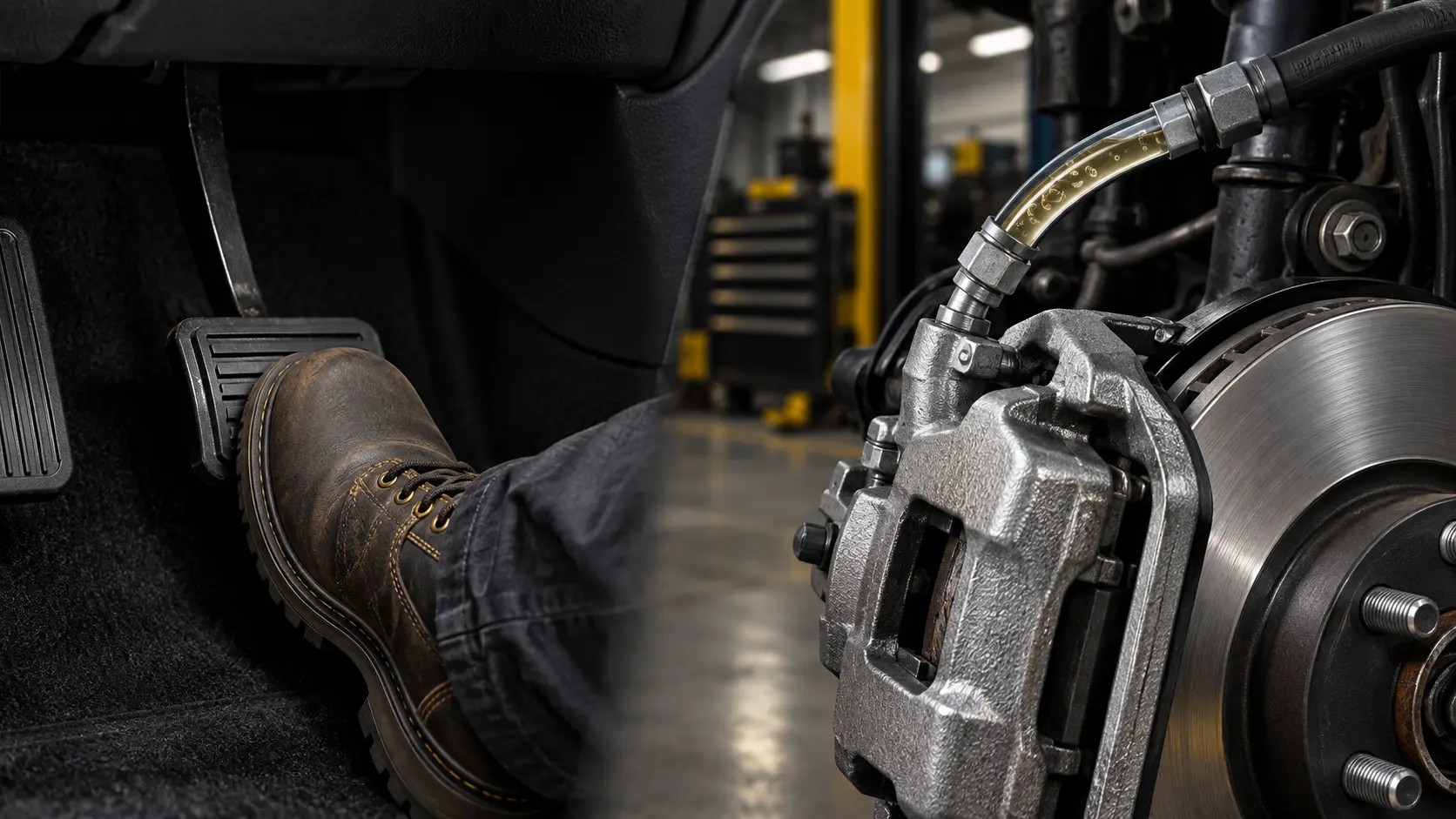
Short answer: if your brake pedal suddenly feels soft or travels farther than usual, do not assume it only needs brake pads or a quick fluid top-off. A soft pedal can come from air in the hydraulic system, a fluid leak, a failing hydraulic component, overheated fluid, or a problem left after recent brake work. If the pedal approaches the floor, braking has weakened, a red brake warning light is on, or fluid is leaking, park safely and arrange towing rather than testing it again.
The way the pedal behaves, when the change started, and whether the hydraulic system was recently opened help narrow the cause. The pedal alone cannot identify the failed part.
What does “soft” or “spongy” actually feel like?
Drivers use several words for pedal problems, and the distinction is useful. Try to describe what you feel without repeatedly driving the vehicle:
- Soft or spongy: the pedal compresses with a springy or cushion-like feeling instead of becoming firm.
- Low pedal: the pedal travels farther toward the floor before the brakes respond normally.
- Sinking pedal: the pedal continues moving downward while you hold steady pressure.
- Pedal that firms when pumped: the pedal temporarily improves after two or more presses, but the underlying problem remains.
- Hard pedal: the pedal is unusually difficult to press. This points in a different direction than a soft pedal and may involve lost power assist.
These descriptions overlap, so they are starting clues—not final diagnoses. A technician still needs to inspect the fluid level, hydraulic components, friction parts, warning lights, and recent repair history.
Common reasons a brake pedal turns soft
1. Air entered the hydraulic system
Brake fluid transfers pedal force because liquid does not compress the way air does. If air enters after a caliper, hose, master cylinder, or another hydraulic component is opened, the pedal can feel spongy because the trapped air compresses before full pressure reaches the brakes.
Bleeding is not simply opening every screw until fluid appears. The correct fluid, sequence, fluid level, bleeding method, and vehicle-specific ABS procedure matter. If air remains trapped—or enters while the reservoir runs low—the pedal may stay soft.
2. Brake fluid is escaping
A leaking flexible hose, caliper seal, wheel cylinder, steel brake line, master cylinder, fitting, or bleeder can reduce hydraulic pressure. The leak may leave a wet area near a wheel, a puddle under the vehicle, or a falling reservoir level. Some leaks are hidden behind a wheel or inside another component.
Safety materials filed with the National Highway Traffic Safety Administration document the important pattern: fluid loss can be followed by a low-fluid warning, a soft or spongy pedal, and reduced braking performance. See the NHTSA-hosted manufacturer notice.
3. The master cylinder is not holding pressure
The master cylinder converts pedal movement into hydraulic pressure. Worn or damaged internal seals can allow pressure to bypass inside the cylinder even when no external puddle is visible. A pedal that slowly sinks while steady pressure is held can be one clue, but that symptom needs professional testing because leaks, ABS hydraulic problems, and other faults can overlap.
4. Heat or old, moisture-contaminated fluid is affecting performance
Brake fluid can absorb moisture over time. Under enough heat, contaminated fluid has a lower boiling point and can form compressible vapor. This is more likely after severe brake drag, repeated heavy braking, or another overheating event than during ordinary driving.
If the soft pedal follows a burning smell or one unusually hot wheel, the heat source must be found too. Read the related guide on a sticking caliper versus a restricted brake hose.
5. Recent brake work is incomplete or has another problem
After pads are installed and caliper pistons are pushed back, the pedal must be pressed until the pads are seated against the rotors before the vehicle moves. If a hose, caliper, or bleeder was opened, the hydraulic system must also be bled correctly. A loose fitting, upside-down caliper with the bleeder below trapped air, low reservoir, damaged seal, or unfinished bleeding can leave a soft pedal.
A consistently soft pedal after brake work is not something to “break in” on the road. Recheck the work before driving.
Why pumping the pedal is not a repair
Pumping may temporarily make a pedal feel higher because repeated strokes can move more fluid, take up clearance, or momentarily build pressure. That temporary improvement does not prove the vehicle is safe. The next stop may require more pedal travel again.
Likewise, adding fluid does not explain why the reservoir was low. The level can change as friction parts wear, but it can also fall because of a leak. Adding fluid without inspecting the system can hide useful evidence and does not restore a leaking component.
How Peoria winters can complicate the inspection
Central Illinois vehicles spend winter in salt, brine, moisture, slush, and repeated freeze-thaw cycles. Corrosion can build around steel brake lines, hose brackets and fittings, calipers, bleeder screws, pad hardware, and mounting surfaces. That does not mean road salt is automatically the cause of a soft pedal, but it means the entire system deserves a visual inspection instead of assuming a routine bleed will solve it.
Heavy rust can also change what is reasonable for mobile work. A brake hose or caliper job that looks straightforward may reveal a seized fitting or fragile steel line. Advanced ABS hydraulic faults, hard-line fabrication, drum systems, and repairs that require heat or extended extraction may need a properly equipped shop.
What a useful soft-pedal inspection checks
The exact process depends on the vehicle and symptoms, but a careful inspection may include:
- Confirming how the pedal behaves while the vehicle is safely stationary.
- Checking the reservoir level and using only the fluid type specified for the vehicle.
- Looking for wetness at calipers, flexible hoses, fittings, bleeders, steel lines, and the master-cylinder area.
- Checking pad, rotor, caliper, and hardware condition instead of treating pedal feel as a pads-only problem.
- Reviewing anything recently replaced or opened in the hydraulic system.
- Bleeding with the correct procedure when air is suspected.
- Checking for a master-cylinder, ABS hydraulic, adjustment, or other fault if normal bleeding does not restore the pedal.
- Verifying a firm pedal and safe brake operation before normal road use.
Brake manufacturer PowerStop likewise identifies trapped air, leaks, master-cylinder problems, rear-brake adjustment, and other hydraulic concerns as possible soft-pedal causes. Review its soft-pedal diagnostic overview.
When should you stop driving?
Keep the vehicle parked and arrange safe transportation or towing when:
- The pedal reaches or nearly reaches the floor
- Stopping ability is reduced or unpredictable
- A red brake-system warning light stays on with changed pedal feel
- You see brake fluid leaking or the reservoir is empty
- The vehicle pulls severely while braking
- There is smoke, a strong burning smell, or an abnormally hot wheel
- The pedal became soft immediately after brake work and has not been rechecked
If you are already parked safely, do not take another lap around the block to gather evidence. Photos of warning lights or a visible leak can help, but do not crawl under an unsupported vehicle or touch hot brake parts.
Is a soft pedal the same as needing pads and rotors?
No. Pads and rotors are friction components; a soft pedal usually points toward hydraulic pressure, air, fluid loss, adjustment, or component movement. The vehicle may need friction parts too, but buying pads first can waste money when the actual concern is a hose, caliper, leak, master cylinder, or another hydraulic fault.
If your main symptoms are noise, scoring, or vibration instead, compare the guide to when Peoria drivers may need pads, rotors, or both. If the brakes are already making metal-on-metal noise, see what grinding brakes can mean.
What to text JL Brake Service for a faster next step
Send:
- The vehicle year, make, and model
- Whether the pedal feels soft, low, sinking, hard, or temporarily firms when pumped
- When the change started and whether brake work was done recently
- Any red brake or ABS warning lights
- Any fluid under the vehicle, burning smell, hot wheel, pulling, or grinding
- Your ZIP code and whether the vehicle is safely parked
JL Brake Service focuses on disc-brake pads and rotors, calipers, flexible hoses, and bleeding for qualifying Peoria-area jobs. Conditions involving hard brake lines, drum brakes, advanced ABS hydraulics, or other work outside that scope may require service at another properly equipped facility.
Frequently asked questions
Can worn brake pads cause a soft pedal?
Worn pads can affect reservoir level and pedal travel on some systems, but a distinctly spongy or sinking pedal should not be diagnosed as “just pads.” The hydraulic system and the complete brake assembly need to be checked.
Do brakes need bleeding after changing pads?
A normal pad replacement does not open the hydraulic system, so bleeding is not automatically required. The pedal still must be pumped firm before the vehicle moves. If a bleeder, hose, caliper, or other hydraulic connection was opened—or the pedal remains soft—the system needs to be inspected and bled as required.
Can a brake hose cause a soft pedal?
A leaking or expanding damaged hose can affect pedal feel. An internally restricted hose more often creates brake drag or a hot wheel. Because hose faults can behave differently, visible condition and hydraulic testing matter.
Can I drive if pumping makes the pedal firm?
Do not rely on pumping as a repair. A pedal that needs repeated presses to become firm has a problem that should be evaluated before normal driving.
Get help with a soft brake pedal in Peoria
If the vehicle is safely parked, call or text 309-215-1599. Send the year, make, model, pedal symptoms, warning lights, recent brake work, and ZIP code. If braking is reduced, fluid is leaking, or the pedal is near the floor, arrange towing instead of driving to an appointment.
Text the symptoms