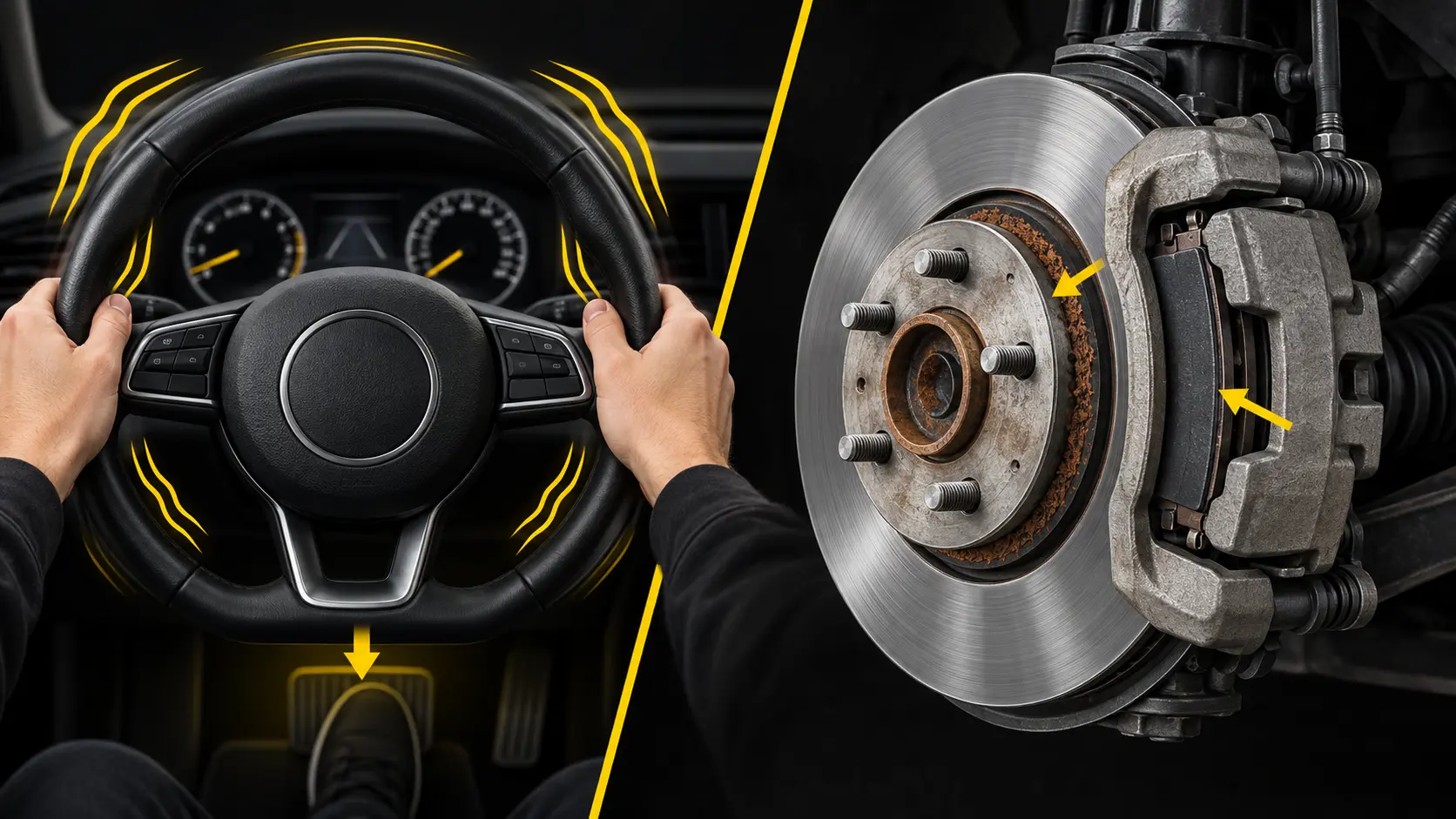
Short answer: when the steering wheel is smooth while cruising but shakes as the brakes are applied, the front rotors and the way they sit on the hubs are common places to investigate. Uneven rotor thickness, lateral runout, friction-material deposits, rust or debris at a mounting surface, or a brake that is not releasing evenly can all contribute. A loose wheel bearing, worn steering or suspension part, or tire problem can overlap, so buying rotors before checking the whole corner can miss the cause.
What the location of the shake can tell you
Mostly in the steering wheel
When it appears only while braking, the front brake, rotor, hub, steering, and suspension components deserve close attention.
Mostly in the pedal, seat, or floor
The braking system may still be involved, but the location alone cannot identify which axle or part needs service.
Present while cruising too
A tire, wheel, wheel bearing, axle, or steering and suspension issue becomes more important to rule out before blaming the brakes.
Brake-system supplier ADVICS notes that front rotor issues can be felt as steering-wheel shake under brake pressure, while rear rotor issues may be felt more through the seat, floor, or pedal. That is a diagnostic clue—not proof that a rotor is the only problem. See ADVICS rotor troubleshooting guidance.
Five possible causes of steering-wheel shake during braking
1. Rotor thickness variation or lateral runout
A rotor should turn with its friction faces running true. If thickness varies around the disc or the rotor does not rotate in a consistent plane, the pad contact can change on every revolution. The driver may feel that repeating force as pedal pulsation or steering-wheel shake, especially during moderate or higher-speed stops.
The phrase “warped rotor” is often used for any brake vibration. It is more useful to measure rotor thickness and runout and inspect the friction surface than to rely on that label. Heat stress, uneven friction transfer, installation conditions, and component quality can all matter.
2. Rust or debris between the rotor and hub
The rotor must sit flat against the hub mounting face. Scale, corrosion, or debris trapped between those surfaces can keep the rotor from seating evenly. Installing a new rotor over an unprepared mounting face can leave the underlying problem in place.
This is practical Peoria context, not a diagnosis from the weather. IDOT confirms that Illinois winter operations use rock salt and liquid deicers. Moisture, freeze-thaw cycles, winter residue, and vehicles that sit outdoors make careful inspection of exposed metal surfaces especially important in this region.
3. A caliper, slide, or pad is not moving evenly
A sticking caliper piston, seized slide pin, or pad bound in rusty hardware can create uneven pressure and heat. One side may wear faster, the vehicle may pull, or one wheel may run hotter. A restricted flexible brake hose can sometimes contribute to a brake that releases slowly. If heat or pulling is part of the complaint, read JL's guide to one hot wheel, a sticking caliper, and a restricted brake hose.
4. Wheel-bearing movement or a hub problem
A loose or worn bearing can affect how the rotor and wheel run under load. It may also produce humming, growling, or a change with steering. JL's wheel-bearing noise guide explains how to describe those overlapping symptoms without guessing which part to order.
5. Tire, wheel, steering, or light-suspension wear
A bent wheel, damaged tire, imbalance, worn tie-rod end, ball joint, control-arm bushing, or another loose component may be more noticeable as the vehicle's weight shifts forward during braking. If the shake also occurs at a certain road speed without touching the pedal, the inspection should not stop at the brake rotor.
Why “just replace the rotors” can be incomplete
Rotors may need replacement when they are below specification, damaged, severely corroded, or responsible for measured variation that cannot be corrected within manufacturer limits. But new parts are not a substitute for finding the cause. A useful service checks the mounting face, rotor condition and measurements, pad wear pattern, caliper movement, wheel-bearing play, and nearby steering or suspension parts as the vehicle allows.
ADVICS also emphasizes correct installation and following the brake-pad and rotor manufacturer's bedding procedure. Proper wheel fastener tightening and clean mating surfaces matter because the repair has to leave the rotating assembly seated and clamped as intended.
Brake pulsation or normal ABS operation?
ABS activation during a hard stop or on a slick, loose, or uneven surface can create rapid pedal feedback. That is different from a repeatable shake during ordinary braking on dry pavement. Do not perform hard-braking tests to diagnose it yourself. Simply note whether the symptom appears during normal stops, at a certain speed, or only when traction is poor.
What to tell Jimmy before an inspection
You do not need to name the failed part. These details make the conversation more useful:
- Does the steering wheel shake only while the brake pedal is pressed?
- Is the vibration stronger at city speed, highway speed, or during downhill stops?
- Do you also feel pulsing in the pedal, seat, or floor?
- Does the vehicle pull left or right, smell hot, or have one wheel that feels unusually hot nearby?
- Is there grinding, squeaking, humming, a warning light, or a change in pedal feel?
- Were the brakes, tires, wheels, or suspension recently serviced?
- What are the year, make, model, and Peoria-area ZIP code?
Do not keep driving to “see if it clears” if the vehicle pulls hard, the steering feels loose, braking is weaker, the pedal is soft or sinks, a red brake warning light is on, fluid is visible, or there is severe grinding, smoke, or a strong burning smell. Arrange towing when the vehicle does not feel safe to stop or steer.
What a brake-vibration inspection should check
- When the vibration occurs and where it is felt
- Inner and outer brake-pad thickness and wear pattern
- Both rotor faces, thickness, surface condition, and runout when appropriate
- Hub and rotor mounting surfaces for rust, scale, or debris
- Caliper piston, slide-pin, pad, and hardware movement
- Signs of heat, drag, leakage, or a flexible-hose problem
- Wheel-bearing, tire, wheel, steering, and light-suspension clues
JL's Peoria brake inspection page explains the current brake-focused service scope. If pads or rotors are confirmed, the brake pads and rotors guide explains when each part may be needed and how JL's published labor pricing works.
Current JL labor pricing if brake parts are confirmed
Vibration alone does not confirm a parts list. When an inspection supports disc-brake replacement, JL's current published brake pad labor is $120 for one axle or $200 for front and rear together. Adding rotors with the pad service is another $90 per axle in labor. Brake-caliper replacement labor starts at $120 per axle. Parts are separate unless the written quote includes them. Rust, broken hardware, vehicle design, or added repairs can change labor, and any change should be discussed before extra work begins.
JL Brake Service schedules qualifying mobile work within roughly 15 miles of Peoria, including many locations in Peoria, Dunlap, Washington, Morton, Germantown Hills, Edwards, East Peoria, Peoria Heights, Pekin, and West Peoria. A $40 mobile booking deposit reserves the appointment and travel; repair labor and parts are separate. The vehicle needs a safe, firm, reasonably level, off-street work area.
Frequently asked questions
Is steering-wheel shake while braking always warped rotors?
No. Rotor thickness variation or runout may be involved, but hub corrosion, uneven friction material, brake drag, a wheel bearing, tire, wheel, or steering and suspension wear can overlap. The symptom needs inspection before parts are ordered.
Why does my steering wheel shake more when braking at highway speed?
A repeating variation can become easier to feel as the wheel and rotor turn faster and the brakes are loaded. Highway-speed shake can also expose tire, wheel, bearing, or suspension problems, so speed alone does not prove the rotors are bad.
Can a sticking caliper make the steering wheel shake?
It can contribute through uneven pressure, heat, or pad and rotor wear. Pulling, a hot smell, or one wheel running hotter makes caliper, slide, pad fit, and flexible-hose checks especially important.
Can new brake rotors still vibrate?
Yes. A rotor can sit unevenly on a rusty or dirty hub, installation or wheel-fastener issues can matter, and a bearing, tire, wheel, or suspension problem can remain after brake parts are changed. New does not automatically mean the cause was corrected.
Tell Jimmy exactly when it shakes
Call or text 309-215-1599. Send the year, make, model, speed range, where you feel the vibration, any pulling, noise, heat, warning lights, recent repairs, and the ZIP code where the vehicle is parked. Jimmy can discuss whether a qualifying Peoria-area mobile inspection or repair fits JL's current service scope.
Text the vibration detailsTechnical references: ADVICS Aftermarket North America, Troubleshooting and Mitigating Brake Rotor Problems and Tips for Addressing Brake Rotor Warpage; Illinois Department of Transportation, Road Salting 101. Accessed September 12, 2026.