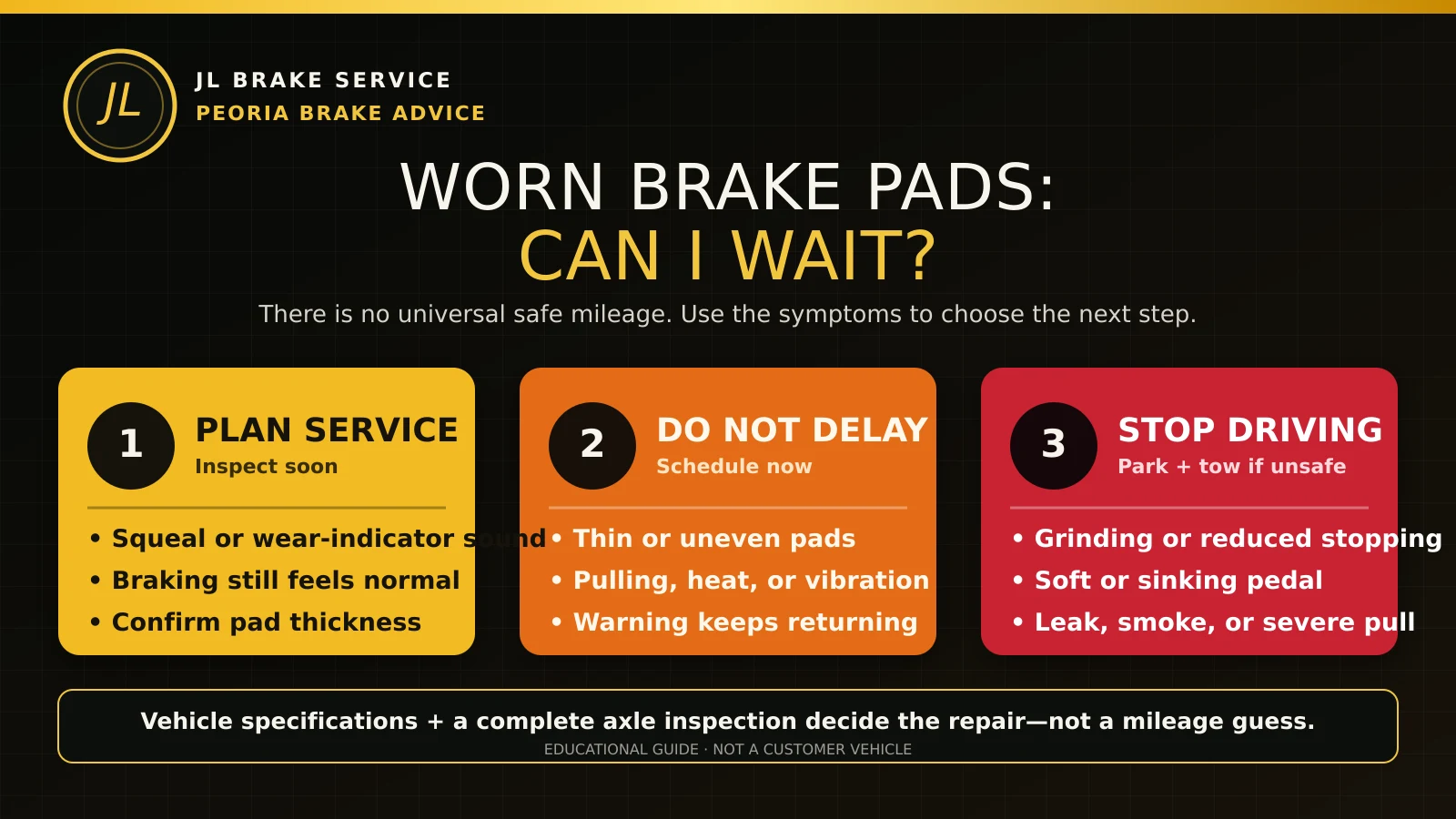
Short answer: do not count on a fixed number of days or miles after someone says the brake pads are worn. “Worn” can mean a wear indicator has started to squeal, a pad is already near its limit, one hidden pad is thinner than the outside pad, or friction material is gone and metal is contacting the rotor. The safe next step depends on the actual condition and the way the vehicle is braking.
Three levels: inspect soon, schedule now, or stop
Plan an inspection soon
A new squeal or wear-indicator sound appears, but pedal feel, stopping distance, and vehicle tracking have not changed.
Do not delay service
Pads are measured thin, wear is uneven, or you notice repeated vibration, pulling, extra heat, or a warning that keeps returning.
Stop driving
Grinding continues, stopping is weaker, the pedal feels soft or sinks, fluid is leaking, a wheel smokes, or the vehicle pulls severely.
Why nobody can promise “you have 500 miles left”
Brake pads do not lose material at the same rate on every vehicle. City traffic, highway driving, vehicle weight, hills, towing, driving habits, pad material, and the condition of the caliper and hardware can all change the rate. The inner and outer pads can also wear differently. Looking through a wheel at one outside pad may miss the thinnest pad.
Industry guidance is not built around one universal replacement thickness. ADVICS notes that recommendations can vary, and rotor decisions must also follow the vehicle manufacturer's minimum specification. AAA treats a wear-indicator sound and visibly thin pad material as reasons to have the brakes checked. That supports an inspection-first answer—not a promise about miles remaining.
Common mistake: waiting until the brakes grind
Grinding is not a useful reminder to schedule routine pad service. It can mean the friction material is exhausted and metal parts are contacting the rotor. Continuing to drive may turn a pad-only job into a larger repair and can reduce braking performance.
What an inspection should compare
A useful disc-brake check compares both wheels on the axle instead of judging one visible pad. It should consider:
- Inner and outer pad material on both sides
- Even or uneven wear from left to right
- Rotor surface and the applicable minimum thickness
- Caliper piston, slide-pin, pad, and hardware movement
- Flexible hose condition and visible fluid leaks
- Whether the brake applies and releases normally
If one pad is much thinner, replacing pads alone may not address the reason it wore faster. Read JL's guide to uneven brake pad wear for the conditions that should be checked before parts are chosen.
Peoria fall and winter make “wait and see” harder
Central Illinois brings moisture, freeze-thaw cycles, snow, and road salt. IDOT uses salt and other winter materials to improve road conditions. Those materials do not prove what failed on a specific vehicle, but repeated moisture and corrosion can affect exposed hardware, pad contact points, slide-pin boots, rotor and hub surfaces, and hose fittings. A brake that was already moving poorly may wear unevenly or run hot.
Before winter, a new squeal, hot wheel, pull, vibration, or repeated warning deserves a real inspection. Winter weather also increases stopping demands, so NHTSA recommends slowing down and leaving more distance between vehicles. Good driving habits help, but they do not repair worn pads.
What worn brake-pad service costs at JL
JL's current disc-brake pad labor is $160 for the front or rear axle and $240 for front and rear. If pads and rotors are confirmed, labor is $250 for the front or rear axle and $420 for front and rear. Parts are vehicle-specific and separate.
The $40 upfront toward your total reserves the scheduled visit and travel. Jimmy confirms the vehicle, parts, service area, work surface, and job scope before booking. Qualifying mobile service is available around Peoria and nearby communities; there is no public walk-in address.
Worn brake pad questions
Can I drive a few days with squealing brakes?
A squeal can come from a wear indicator, moisture, debris, or another brake condition. If braking still feels normal, arrange an inspection soon instead of choosing a number of days. If stopping, pedal feel, tracking, heat, smell, or warning lights change, park the vehicle.
How many miles are left when pads measure about 3 mm?
No dependable mileage conversion exists. Remaining life depends on the vehicle, pad design, driving, wear pattern, and whether the brake applies and releases normally. Follow the vehicle specification and inspection result.
Does grinding mean the pads are completely gone?
It may mean friction material is exhausted, but other brake and wheel-area conditions can also grind. Persistent grinding is a stop-and-inspect symptom, not something to diagnose by sound alone.
Send the symptom before buying parts
Call or text 309-215-1599 with the year, make, model, ZIP code, what you hear or feel, and whether braking has changed. Jimmy can confirm whether the vehicle and location fit JL's current Peoria-area mobile service.
Text Jimmy the brake detailsSources: AAA, 11 Ways to Know You May Need New Brakes; ADVICS Aftermarket North America, Troubleshooting and Mitigating Brake Rotor Problems and Brake FAQs; Illinois Department of Transportation, Winter Weather Operations; National Highway Traffic Safety Administration, Winter Weather Driving Tips. Accessed October 12, 2026.