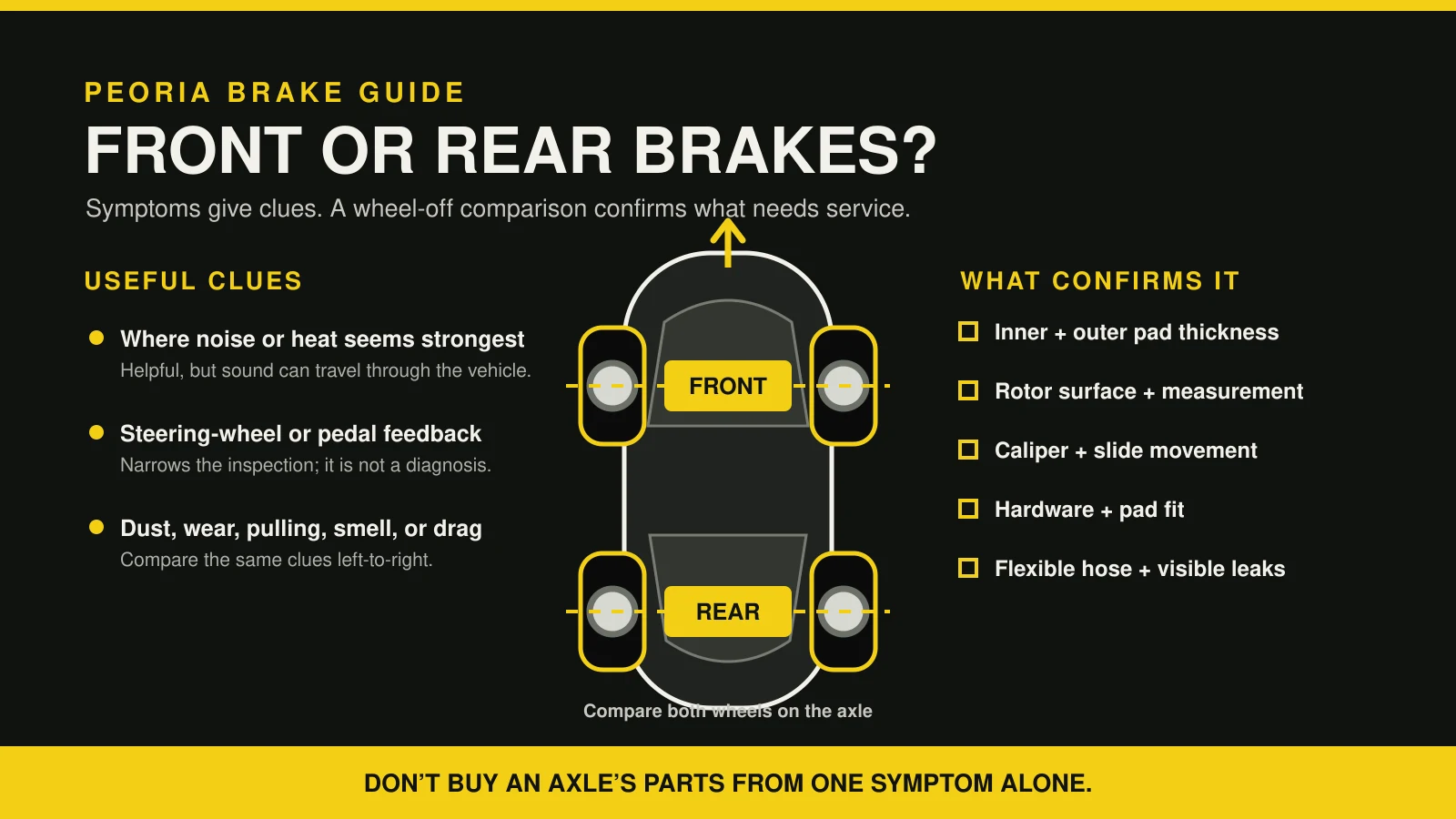
Short answer: you may be able to narrow the concern to the front or rear brakes, but do not order parts from sound location or pedal feel alone. Noise can travel through the body, steering feedback can have more than one cause, and the pad visible through a wheel may not match the hidden pad. A useful inspection compares inner and outer pad thickness, rotor condition, caliper and hardware movement, flexible hoses, and both wheels on the axle.
What clues can point toward the front or rear brakes?
Noise seems strongest near one wheel
A repeatable squeal, scrape, click, or grind near one corner is useful information. Listen for whether it occurs only while braking, during the first stops after rain, or even while coasting. Do not put yourself beside a moving vehicle to locate it.
The steering wheel shakes while braking
Feedback in the steering wheel can make the front axle an important place to inspect. Rotor thickness variation, hub mounting conditions, tires, wheel bearings, and steering or suspension movement can overlap, so the symptom still needs confirmation.
One wheel is hotter or dirtier
Extra brake dust, a burning smell, or heat near one wheel can point toward drag at that corner. Do not touch the wheel, rotor, or caliper to compare temperatures. A sticking caliper, restricted flexible hose, pad fit, or hardware movement may need to be checked.
The vehicle pulls during braking
Pulling means the vehicle is not behaving evenly, but it does not automatically tell you which side is bad. Brakes, tires, wheel bearings, and front-end movement can create similar complaints. Severe pulling is a reason to park the vehicle.
Why the symptom alone can be misleading
Brake noise travels
A metal rotor, wheel, hub, suspension, and vehicle body can carry sound away from its source. What sounds like the rear seat or one front corner from the driver's position may not match the wheel where the problem is found. The timing of the noise—braking, releasing, turning, or coasting—is often more useful than direction alone.
The outside pad is only half the pad story
Looking through the wheel may reveal one outer pad and part of the rotor. The inner pad can wear differently because of piston, slide-pin, pad-fit, or hardware concerns. A clean outer pad does not prove the brake corner is healthy, and one rusty-looking rotor after a damp night does not prove it needs replacement.
Front and rear specifications can differ
Brake size, pad shape, rotor design, electronic brake controls, and allowable measurements vary by vehicle and axle. The correct front and rear parts should be matched by year, make, model, engine or trim when required, and preferably VIN. Rotor and pad decisions should follow the applicable vehicle specifications—not a universal thickness guess.
What confirms which brakes need service?
A wheel-off comparison should establish which axle is worn or damaged and whether the concern is routine friction wear or a problem affecting application and release. Depending on the symptom and vehicle, that comparison may include:
- Inner and outer pad material at each disc-brake wheel
- Left-to-right pad wear on the same axle
- Rotor surfaces, grooves, scaling, heat marks, thickness, and runout when appropriate
- Caliper piston, guide-pin, bracket, pad, and hardware movement
- Flexible brake-hose condition and visible hydraulic leaks
- Whether each brake applies and releases normally
- Nearby tire, wheel-bearing, steering, or light-suspension conditions that fit the symptom
ADVICS' brake-system inspection checklist similarly calls for checking pads, rotors, calipers, hoses, leaks, hardware, and related warning signs rather than selecting one part from the complaint alone. A General Motors technical bulletin hosted by NHTSA also directs technicians to measure pad thickness and diagnose causes such as binding pistons, pads, guide pins, or brake-hose restriction when wear is outside specification.
Why Peoria and Illinois corrosion matter
Peoria-area vehicles encounter winter moisture, freeze-thaw cycles, rock salt, and liquid deicers. Those conditions do not prove corrosion caused a particular brake complaint. They do make it important to inspect exposed pad-contact points, hardware, slide-pin boots, rotor and hub surfaces, flexible-hose fittings, and nearby fasteners.
Rust can make a pad or caliper move differently from the matching wheel on the axle. It can also hide behind the outer face that a driver sees through the wheel. Early fall is a practical time to address a new noise, uneven wear, or marginal hardware before repeated winter exposure makes the condition harder to ignore.
Do front and rear brakes have to be replaced together?
Not automatically. The front and rear axles can be at different stages of wear, and a sound from one end does not mean all four wheels need parts. When pads are replaced, they are normally serviced as a complete axle set—left and right together—so both wheels on that axle receive compatible friction material and the same repair decision.
Rotors should be inspected and measured instead of added solely because pads are being replaced. Calipers and flexible hoses should follow diagnosis rather than being treated as automatic add-ons. JL's guide to brake pads versus pads and rotors explains that decision in more detail.
Do not continue driving if the pedal feels soft or sinks, brake fluid is leaking, a wheel smokes or smells strongly burned, the vehicle pulls severely, stopping distance increases, heavy metal-on-metal grinding continues, or a red brake warning light remains on with a braking change. Arrange towing when the vehicle cannot stop or track safely.
How to describe the problem for a faster mobile quote
Send what you know—and “unsure” for what you do not
- Vehicle year, make, model, and Peoria-area ZIP code
- VIN or license plate so the correct vehicle configuration can be checked
- Front, rear, or unsure
- Squeal, scrape, grind, click, vibration, pulling, heat, smell, or pedal change
- Whether it happens while braking, after releasing, while turning, or while coasting
- Any recent brake, tire, wheel-bearing, or suspension work
- Whether the vehicle is parked on a safe, firm, reasonably level, off-street surface
The JL Fast Quote tool can use the NHTSA vehicle database to decode basic VIN details and organize the request into one text message. It cannot inspect the vehicle or guarantee parts fitment; Jimmy uses the information to start a faster, more accurate conversation.
Current JL labor pricing after the axle is confirmed
JL's published labor is $120 for one axle or $200 for front and rear disc-brake pad replacement. Adding rotors with the pad service is another $90 per axle in labor. Brake-caliper replacement labor starts at $120 per axle. Parts are separate unless included in the written quote. Vehicle design, corrosion, damaged hardware, or added work can change labor, and any change should be discussed before extra work begins.
A $40 mobile booking deposit reserves the appointment and travel; repair labor and parts are separate. Qualifying mobile work is scheduled around Peoria and nearby communities such as Dunlap, Washington, Morton, Germantown Hills, Edwards, East Peoria, Peoria Heights, Pekin, and West Peoria. Availability depends on the vehicle, repair, ZIP code, weather, correct parts, and a safe work area.
Front and rear brake questions
Can the sound tell me whether my front or rear brakes are bad?
It can give a useful clue, especially when the noise repeats near one wheel, but sound can travel through the vehicle. Confirm the axle by comparing the brakes rather than ordering parts from direction alone.
If the steering wheel shakes, is it definitely the front rotors?
No. The front brake and hub area should be inspected, but rotor variation, mounting-surface corrosion, tires, bearings, steering, and suspension conditions can overlap. The symptom does not confirm a rotor purchase by itself.
Can only the front or only the rear brakes be replaced?
Yes, when inspection shows only one axle needs service. Pads are normally replaced on both wheels of that axle. The opposite axle does not automatically need parts at the same time.
Can JL inspect which axle needs brakes at my location?
Qualifying mobile inspection or repair may be available when the vehicle is parked on a safe, firm, reasonably level, off-street surface in JL's Peoria-area range. Jimmy confirms the vehicle, symptom, ZIP code, work area, and current service scope before booking.
Not sure whether it is front or rear?
That is okay. Call or text 309-215-1599 with the year, make, model, symptom, when it happens, ZIP code, and whether you already have parts. Jimmy can help determine whether a qualifying Peoria-area mobile inspection or repair fits JL's current scope.
Text the brake detailsTechnical references: ADVICS Aftermarket North America, Brake System Inspection Checklist and Winter Brake System Issues Checklist; General Motors technical bulletin hosted by the National Highway Traffic Safety Administration, Brake Pad Inspection and Uneven Wear Diagnosis. Accessed September 15, 2026.