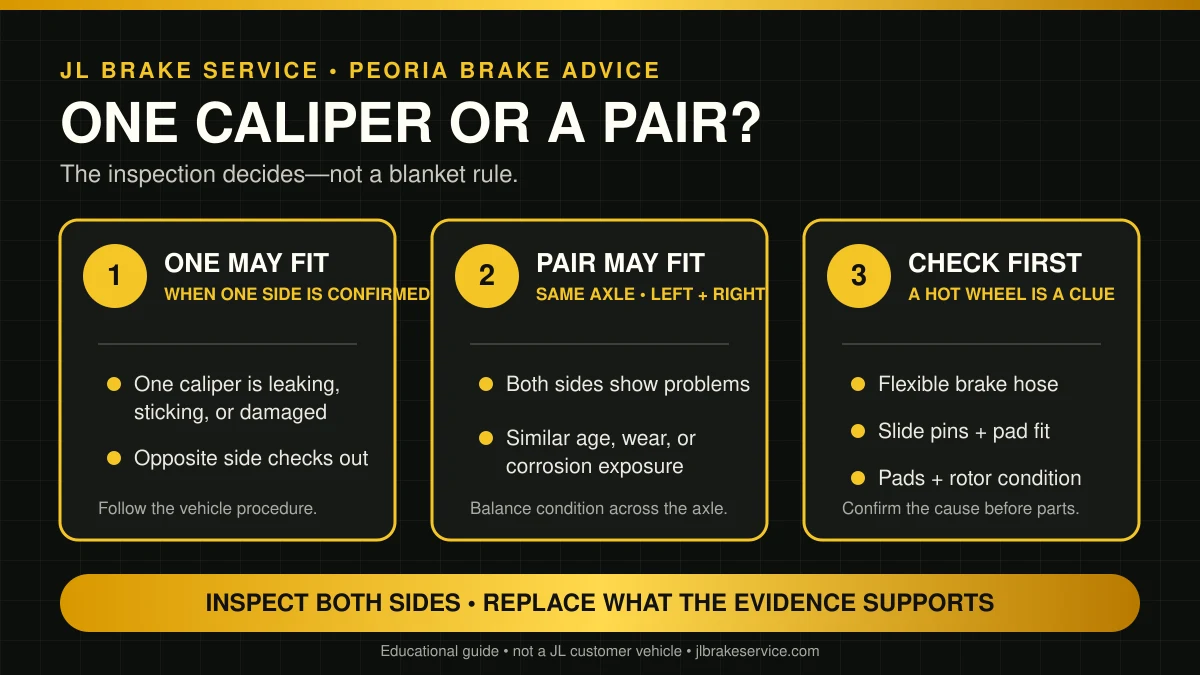
Short answer: brake calipers do not always have to be replaced in pairs. One confirmed failed caliper may be replaced by itself when the opposite caliper applies and releases normally and the vehicle procedure allows it. A same-axle pair may make more sense when both sides show trouble, both have similar corrosion or wear, or the manufacturer procedure calls for matched replacement.
One caliper, a pair, or a different repair?
One caliper may fit
One side is confirmed leaking, sticking, or damaged. The opposite side checks out, and the vehicle procedure permits one-side replacement.
A pair may fit
Both calipers show problems, both have similar age or corrosion exposure, or matched condition across the axle is the better supported repair.
Another part may be the cause
The hose, slide pins, pad fit, bracket, or hardware is keeping the brake from applying or releasing normally.
When replacing one caliper may be reasonable
Replacing one caliper can be reasonable when the evidence is limited to one side. Examples include a visible leak at one caliper, one damaged housing or bleeder, or one piston that does not move correctly while the opposite side passes the same checks.
The other side should still be inspected. PowerStop's caliper guidance says slides and pistons should move freely, pads and rotors should be checked for uneven wear, and lines and fluid should be checked for leaks. It also says replacement should follow the vehicle manufacturer's specifications.
When a same-axle pair may make more sense
A pair means the left and right caliper on the front axle or the left and right caliper on the rear axle—not all four calipers. A same-axle pair may be the stronger choice when:
- Both calipers leak, stick, or fail movement checks
- Both sides have heavy, similar corrosion or damaged boots and hardware
- The opposite caliper is already showing uneven wear or release trouble
- The vehicle or parts procedure recommends pair replacement
PowerStop describes pair replacement as a general good practice for balanced condition and similar service life. That is useful guidance, but it does not replace inspecting both sides or following the procedure for the specific vehicle.
Why a hot wheel does not prove the caliper is bad
The caliper piston is only one part of a disc brake. The caliper also relies on slide pins, pads moving freely in the bracket, intact boots and hardware, and hydraulic pressure that can release through the flexible hose. A restriction or bind elsewhere can leave one brake dragging.
That is why JL's guide to one hot wheel, a caliper, and a flexible brake hose separates the symptom from the diagnosis. Replacing a caliper without confirming the cause can leave the original problem in place.
If a wheel is smoking, brake fluid is leaking, stopping power is reduced, the pedal is soft or sinking, or the vehicle pulls severely, keep it parked and arrange safer transportation or towing. Do not touch a suspected hot wheel or brake.
What should be checked before choosing one or two?
- Caliper piston and slide-pin movement on both sides
- Inner and outer pad wear across the axle
- Pad movement in each bracket and hardware condition
- Rotor heat, scoring, thickness, cracks, and hot spots
- Flexible hose behavior and visible brake-fluid leaks
- The repair procedure for the year, make, model, and brake option
If one pad is much thinner than its mate, read the guide to uneven brake-pad wear. That pattern can help direct the inspection, but it does not identify the failed part by itself.
Peoria winter corrosion can affect the decision
Peoria-area vehicles see moisture, freeze-thaw cycles, salt, and winter road treatment. ADVICS notes that road salt can accelerate rust and corrosion in brake components. PowerStop likewise warns that road salt can contribute to caliper corrosion and seizing.
Similar exposure on both sides is one reason the opposite caliper deserves a careful look. It is not proof that both must be replaced. The inspection should show whether the second side is still moving and sealing correctly.
JL Brake Service caliper labor prices
Standard bleeding and normal fluid are included. Calipers, pads, rotors, hoses, and any related replacement parts are separate unless the written quote includes them. The $40 upfront toward your total reserves the scheduled visit and travel. Qualifying mobile service is available around Peoria and nearby communities; there is no public walk-in address.
Brake caliper replacement questions
Do I need to replace all four brake calipers?
Usually not. The repair should follow the confirmed condition of each caliper and the vehicle procedure. A recommendation to replace in pairs normally means the two calipers on the same axle, not all four.
Can I replace only one front caliper?
Sometimes. One-side replacement may be appropriate when that caliper is confirmed failed, the opposite front caliper checks out, and the vehicle procedure permits it.
Should brake pads be replaced after a caliper sticks?
Not automatically, but both pads and the rotor on that axle should be checked for uneven wear, overheating, scoring, cracking, and thickness. The condition decides what belongs in the repair.
Send the vehicle and the symptoms
Call or text 309-215-1599 with the year, make, model, ZIP code, affected wheel, and what you notice. Jimmy can confirm whether the vehicle and location fit JL's current Peoria-area mobile service before booking.
Text Jimmy the caliper detailsSources: PowerStop, What Are Brake Calipers and When Should You Change Them?; ADVICS Aftermarket North America, Checklist: Winter Brake System Issues to Look Out For; AAA, 13 Common Car Problems Explained. Accessed October 26, 2026.